

Choosing an AI content platform used to be simple, but it depends on what kind of output is needed by your team. A traditional workflow is simple: you pick a tool that could generate decent paragraphs, give it a prompt, and edit the result.
That workflow no longer works for serious SEO and marketing teams. Today, creating content that can compete in search requires much more than AI writing. You need keyword research, search intent, SERP analysis, content structure, E-E-A-T signals, on-page SEO, humanization, internal linking, and a practical publishing workflow.
That is where the Writesonic vs Rext AI comparison becomes interesting. Both platforms can help teams create AI-assisted content and go beyond basic text generation. But they approach the content workflow differently.
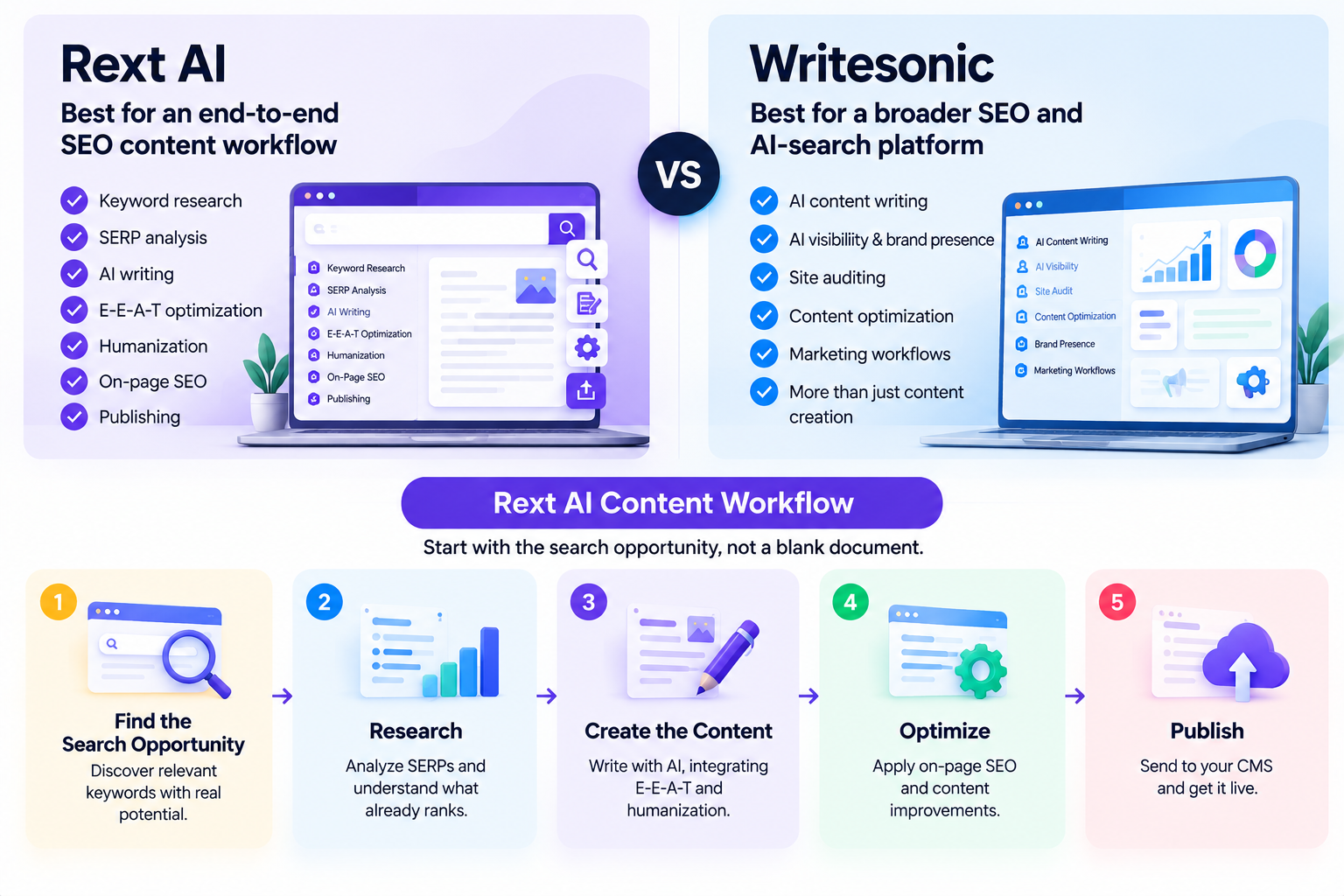
Writesonic has expanded into a broader AI search visibility and marketing platform, with tools for AI article creation, SEO research, site audits, AI search visibility, and content optimization. Rext AI takes a more focused approach: connecting keyword research, SERP analysis, content creation, E-E-A-T optimization, humanization, on-page SEO, and publishing into one SEO content workflow.
So which platform makes more sense, and which is right for you? The answer depends on what you need your content operation to accomplish.
If your priority is SEO-focused content production from keyword to published article, Rext AI deserves a close look. If you need a broader platform covering AI search visibility, site auditing, content strategy, and multiple marketing workflows, Writesonic may fit that broader requirement.
This guide compares the two across features, workflow, SEO capabilities, content creation, publishing, pricing, agencies, and practical use cases.
What is Writesonic, and how is it different from other platforms?
Writesonic is a broader AI content and marketing platform. Its current product ecosystem covers AI article writing, SEO research, content strategy, AI search visibility, site audits, optimization, and other marketing workflows.
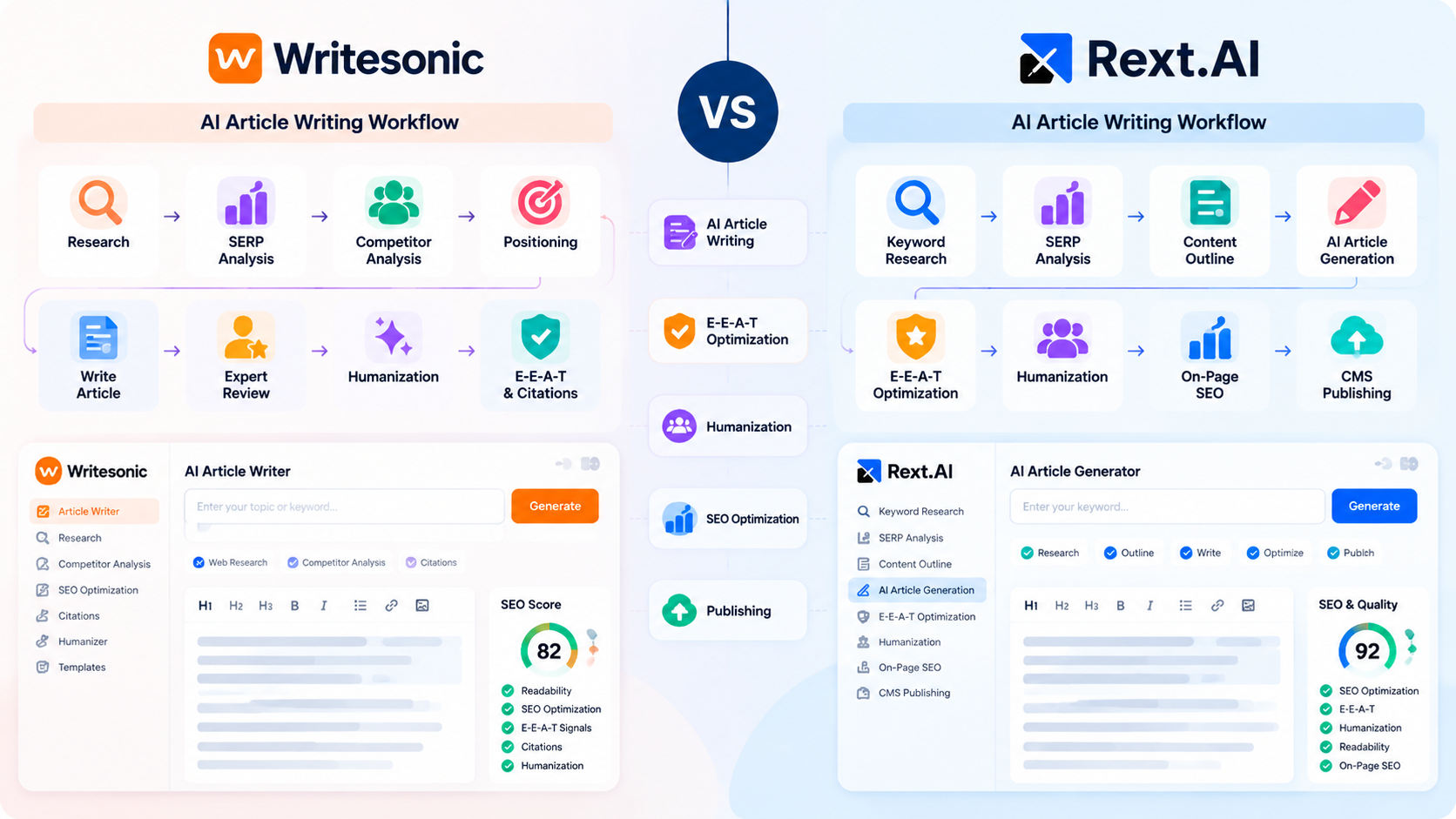
Its AI Article Writer follows a multi-stage process that includes research, SERP and competitor analysis, outlining, writing, review, humanization, E-E-A-T, and citations.
Writesonic also has dedicated functionality around AI search visibility and GEO. That makes it more than a traditional AI writer. Writesonic can therefore be a strong choice for organizations looking beyond conventional blog production.
The important question is whether you need that broader platform or whether your main objective is a streamlined SEO content workflow.
What Is Rext AI and why is it an alternative to Writesonic?
Rext AI is an AI-powered SEO content platform built around the complete content production process. Instead of treating writing as the starting point, Rext begins with the search opportunity.
A typical workflow looks like this:
Keyword Research → SERP Analysis → Outline → Article → E-E-A-T → Humanization → On-Page SEO → Publishing
That distinction matters.
A content team does not need another blank AI editor. It needs a repeatable process that turns a target keyword into a publishable, search-focused article.
Rext AI brings those steps together inside one platform.
Its current feature set includes:
- Deep keyword analysis
- Search volume and keyword difficulty
- Search intent
- SERP analysis
- AI article generation
- Structured outlines
- E-E-A-T optimization
- Humanization
- On-page SEO
- Meta title and description generation
- Image alt text
- Internal linking suggestions
- Schema-ready content
- Brand voice
- AI image generation
- CMS publishing
- Bulk publishing
- Content workflows for teams and agencies
That makes Writesonic particularly relevant for people who manage SEO content at scale.
Instead of generating an article first and figuring out the SEO afterward, the SEO workflow stays connected to content creation.
Why Do Users Look for Writesonic Alternatives?
Writesonic is a capable platform, and many teams use it daily without problems. Still, a tool that suits one team can be a poor fit for another. Most people searching for alternatives are not unhappy with AI writing itself, and they want a tool that matches the way their team actually works.
Here are the most common reasons.
1. The platform is broader than some teams need
Writesonic now covers article writing, SEO research, site audits, AI search visibility, and more. That range is useful for larger marketing teams, but if your goal is simply to research a keyword, write an article, and publish it, you may be paying for features you rarely open.
2. Pricing is a bigger commitment for small teams
Writesonic's Starter plan is listed at $79/month when billed annually. For a freelancer, a small business, or a new website, that is a meaningful monthly cost, especially if only part of the platform gets used.
3. The workflow still feels scattered
Many teams find themselves moving between a keyword tool, an AI writer, an SEO editor, and a CMS. Even when one platform covers several of these steps, people often want a more direct path from keyword to published post.
4. SEO-focused teams want a narrower setup
If your main output is organic content, you may prefer a platform built around that one job: keyword research, SERP analysis, on-page optimization, and publishing in a single flow, without extra layers for other marketing tasks.
5. Agencies need more control over volume and clients
Agencies manage multiple websites, brand voices, and writers at once. They look for workspaces, predictable usage costs, and a process they can repeat across clients without rebuilding it each time.
6. Drafts still need heavy editing
No AI tool removes the need for human review. Still, users want drafts that read naturally, follow search intent, and need less rework before they go live. If a tool does not deliver that consistently, people start comparing options.
Why an Alternative Is Worth Considering
Looking at alternatives does not mean your current tool has failed. It means you are checking whether you are paying for the right things.
A quick comparison can show whether you are overpaying for features you do not use, juggling more tools than you need, or missing a workflow built around your actual content goals. In most cases, the right choice is the platform that removes the most friction from your process without lowering your quality standards.
That is the context in which Rext AI becomes a practical option to consider.
How Rext AI Solves These Problems
Each reason above points to the same need: a tool that fits the way your team actually produces content. Rext AI is built around that need. Here is how it handles each problem.
A focused platform instead of a crowded one
Rext AI does one job: it turns a target keyword into a published, search-focused article. Keyword research, SERP analysis, outlining, writing, and publishing all happen in one place. There is no extra suite to learn, so your team spends time on content instead of on navigating features it never uses.
A lower entry price and clearer costs
Rext AI's Starter plan begins at $39/month, with Growth at $89, Pro at $189, and Agency at $399. It runs on credits, and each action, including keyword research, article generation, humanization, and publishing, has a listed credit cost. That makes it easy to estimate what a month of content will cost before you commit.
One connected workflow
Rext AI links each stage to the next. The keyword you choose shapes the SERP analysis, the SERP analysis shapes the outline, and the outline shapes the article. Nothing needs to be copied between a keyword tool, a writer, an SEO editor, and a CMS.
SEO built into the writing process
Search intent, meta titles and descriptions, image alt text, internal linking suggestions, and schema-ready structure are part of the article workflow itself. You do not finish a draft and then start a separate optimization pass in another tool.
Support for agencies and multi-site teams
Higher plans offer multiple workspaces and team members, along with brand voice settings and bulk publishing. An agency can keep each client's content separate and run the same process across all of them, with direct CMS publishing, including WordPress, at the end.
Cleaner drafts that need less rework
Rext AI includes dedicated E-E-A-T optimization and humanization stages. These improve credibility signals, sentence flow, and readability before the draft reaches an editor. Your team still needs to fact-check, add original examples, and apply editorial judgment, but the starting point is stronger.
What to Keep in Mind
Rext AI is not trying to be everything. If AI search visibility tracking or site auditing is your main requirement, Writesonic offers more in those areas. But if your goal is to produce optimized and human-like content steadily, from keyword to published post, Rext covers that path without extra layers.
Rext AI vs Writesonic for SEO Content Creation
This is where the comparison really matters because an SEO article usually has several stages:
- Find a valuable keyword.
- Understand search intent.
- Study competing pages.
- Identify content gaps.
- Build the outline.
- Write the article.
- Improve topical coverage.
- Add E-E-A-T signals.
- Humanize the content.
- Optimize on-page elements.
- Add internal links.
- Publish and monitor.
If your team performs those steps manually across several tools, the process becomes fragmented. Rext AI is designed to connect those stages.
Keyword Research
Rext AI's AI keyword analysis helps users evaluate factors such as:
- Search volume
- Keyword difficulty
- Search intent
- Related keyword opportunities
- High-volume opportunities
- Lower-competition terms
That gives the content team a starting point before writing begins. The advantage is not simply finding a keyword instead, the advantage comes from using the keyword as the first step in a connected content workflow.
SERP Analysis
After selecting a topic, you need to understand what Google currently shows for that query. Rext AI's SERP analysis helps examine the top search results and use that information when planning the article.
Rext AI’s SERP analysis helps answer questions such as:
- What topics do competing pages cover with the type of content that ranks?
- How are competitors structuring their articles?
- What questions should the article answer?
- What information could make the new article more useful?
That research can then feed directly into content creation.
Writesonic vs Rext AI for AI Article Writing
Both platforms can generate long-form SEO content, but the difference comes down to how the writing fits into the broader workflow.
Writesonic's current AI Article Writer uses a detailed research and review pipeline. Its workflow includes SERP research, competitor analysis, positioning, writing, expert review, humanization, E-E-A-T, citations, and other quality checks.
Rext AI takes a similarly workflow-oriented approach, connecting research, outline generation, article creation, E-E-A-T, humanization, SEO optimization, and publishing.
For teams that primarily need SEO articles, Rext AI keeps the workflow relatively straightforward:
Research → Write → Optimize → Publish.
That simplicity can matter.
Content teams often lose time switching between keyword tools, content generators, SEO editors, optimization platforms, and CMS dashboards.
Rext AI vs Writesonic: How they cover E-E-A-T:
AI-generated content still needs credibility because simply producing grammatically correct paragraphs does not make an article authoritative. Both Rext and Writesonic include E-E-A-T-oriented capabilities in their content workflows.
Rext AI's E-E-A-T optimization focuses on incorporating elements such as:
- Relevant expertise
- Professional insights
- Real examples
- Supporting evidence
- Authority signals
- External references
- Experience-driven information
The goal is to move content beyond generic AI-generated statements.
Humanization: Which Platform Does It Better?
Humanization has become an important part of AI-assisted content workflows because the goal should not be to disguise low-quality content. The goal should be to make AI-assisted drafts more natural, useful, readable, and aligned with the intended brand voice.
Rext AI includes a dedicated humanization stage in its SEO content workflow. It focuses on natural sentence flow, varied phrasing, readability, active and passive voice balance, and natural transitions.
This makes humanization part of the article production process rather than an entirely separate editing task.
Writesonic also includes humanization and review within its current article workflow. For either platform, human editing remains valuable.
AI can accelerate research and drafting, but the main focus points here are that subject-matter expertise, original examples, fact-checking, and editorial judgment matter the most to win users’ trust.
On-Page SEO: Rext AI vs Writesonic
On-page optimization is another major part of the comparison. Rext AI includes SEO optimization as part of the article workflow.
That can cover elements such as:
- Meta title
- Meta description
- Image alt text
- Internal linking suggestions
- Schema-ready structure
- Heading structure
- Keyword placement
This is useful because SEO optimization does not have to happen after the content leaves the writing platform. A marketer can move from article creation into optimization without rebuilding the content elsewhere.
Writesonic also provides SEO tools, keyword research, keyword clustering, content optimization, and broader SEO functionality. If you want a dedicated SEO content workflow, Rext provides a focused path from keyword research to article optimization. If you want SEO plus broader site and AI-search visibility functionality, Writesonic offers a wider ecosystem.
Rext AI vs Writesonic for AI Search and GEO
This is one area where the two platforms deserve a more nuanced comparison. Search is changing. People increasingly use AI platforms to discover information, compare products, research companies, and find solutions.
That creates a new optimization layer commonly called Generative Engine Optimization, or GEO.
Writesonic has invested heavily in AI search visibility capabilities designed around platforms such as ChatGPT, Gemini, and Google AI Overviews.
It also provides content optimization functionality designed to identify opportunities related to AI visibility. Rext AI approaches the topic from the content-production side. Its workflow focuses on creating structured, useful, E-E-A-T-oriented, humanized, SEO-optimized content that can serve both conventional search users and AI-driven discovery. This creates an important distinction:
Writesonic is particularly relevant if AI visibility monitoring is a major requirement.
Rext AI is particularly relevant if you want to produce optimized content efficiently as the foundation of your SEO strategy.
For many businesses, both concerns matter.
The question is which one represents the bigger gap in your current workflow.
Writesonic vs Rext AI for Keyword Research
Keyword research remains the foundation of SEO content. Both platforms provide keyword research capabilities, but teams should look beyond the existence of a keyword tool.
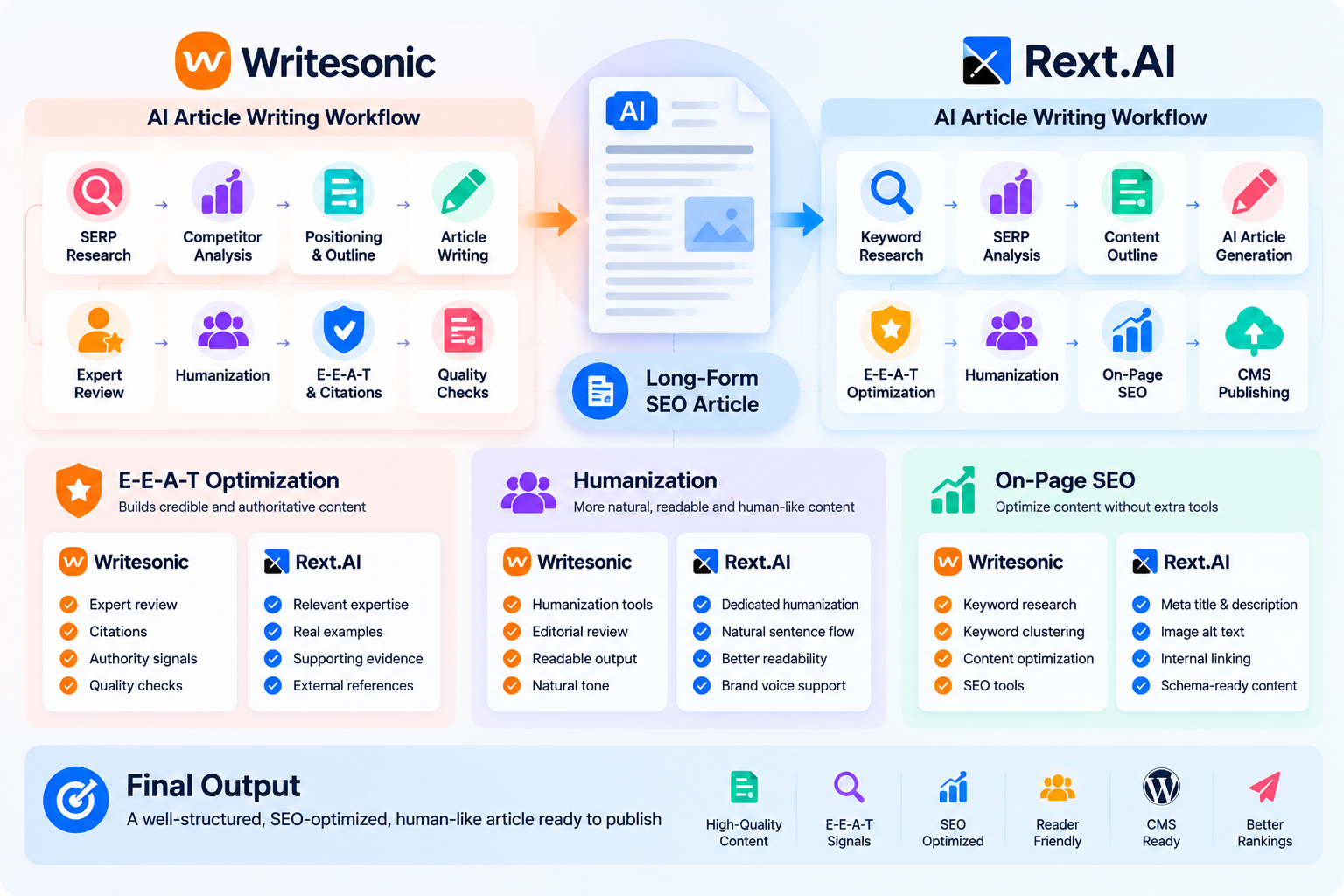
With Rext AI, keyword research leads naturally into SERP analysis, outlining, writing, optimization, and publishing. That makes the keyword part of a continuous workflow.
For example:
Target keyword: AI SEO tools for small business
Rext AI's workflow can move from:
Keyword analysis
↓
Search intent
↓
SERP analysis
↓
Content outline
↓
Article generation
↓
E-E-A-T optimization
↓
Humanization
↓
On-page SEO
↓
CMS publishing
That is much closer to how an SEO content team actually works.
Content Optimization: Writesonic vs Rext AI
Content optimization means more than adding keywords. A useful optimization process should consider:
- Search intent
- Topic coverage
- Related concepts
- Search-result expectations
- Heading structure
- Internal links
- Metadata
- Readability
- Supporting evidence
- User questions
- Content gaps
Rext AI builds these considerations into its SEO content workflow. Writesonic also provides content optimization and SEO functionality, with its newer platform placing greater emphasis on optimization for AI search visibility. So the choice depends on what "optimization" means for your organization.
If optimization means:
"Make this article comprehensive, SEO-focused, well-structured, and ready to publish."
Rext AI is a strong fit.
If optimization means:
"Analyze my existing website for AI-search visibility."
Writesonic's broader platform may be more relevant.
Writesonic vs Rext AI Pricing
Pricing changes frequently, so compare the plans based on your actual monthly workload rather than looking only at the headline number.
Rext AI currently lists:
- Starter: $39/month
- Growth: $89/month
- Pro: $189/month
- Agency: $399/month
Rext AI uses a credit-based model. The platform publishes the credit cost for individual actions and provides estimated article volumes for each plan.
For example, its current pricing page lists keyword research, SERP analysis, article generation, E-E-A-T optimization, humanization, on-page SEO, publishing, and AI image generation as individual actions with defined credit costs. That gives teams a clearer way to estimate usage before subscribing.
Writesonic's current pricing is structured differently.
Its current listed annual pricing starts at $79/month for Starter, with higher tiers designed around broader SEO and AI-search functionality.
That means the two platforms should not be compared purely by monthly price.
They offer different scopes.
A better question is:
How much of your current SEO and content workflow can each platform replace?
If Rext AI replaces several separate steps in your content process, its value comes from workflow consolidation rather than simply article generation.
Which Is Better for Content Agencies?
Content agencies have different requirements from individual bloggers. An agency may manage:
- Multiple clients
- Multiple websites
- Multiple content calendars
- Different brand voices
- High article volumes
- Multiple writers
- Editors
- SEO managers
- CMS publishing
Rext AI is designed with this type of workflow in mind. Its higher plans support multiple workspaces and team members, making it possible to organize different client or brand workflows.
The agency workflow can look like:
Client → Workspace → Keyword Research → SERP Analysis → Content → SEO → Approval → CMS
That creates a repeatable system rather than forcing every client into a separate collection of tools. Writesonic also targets agencies and larger marketing teams, particularly those that need broader SEO and AI-search visibility capabilities.
For an agency focused mainly on scalable SEO content production, Rext AI's workflow-centered approach is especially compelling.
For an agency offering broader SEO, AI visibility, website optimization, and marketing services, Writesonic may offer more breadth.
Rext AI or Writesonic, Which Is Better for Small Businesses?
Small businesses usually face different problems like they do not want another complicated marketing stack.
They want to answer practical questions:
- What should I write about?
- Which keywords should I target?
- What are competitors doing?
- Can AI help me create the article?
- Is the article optimized?
- Can I publish it without moving between five platforms?
Rext AI gives small teams a straightforward path:
Research → Create → Optimize → Publish.
Rext AI is a best platform that can handle multiple SEO tasks without requiring a separate tool for every stage.
For a small business that primarily needs consistent organic content, that focused workflow can reduce operational complexity.
Which Is Better for SEO Agencies?
SEO agencies need more than AI writing. They need the best SEO process can be repeated across websites and clients, but the persona and workspaces must be different for different clients.
Rext AI fits this use case because its workflow connects keyword research, SERP analysis, article creation, E-E-A-T, humanization, on-page SEO, and publishing.
That means an agency can create an internal process around the platform.
For example:
Step 1: Research
SEO strategist identifies the target keyword.
Step 2: SERP analysis
The team reviews the current search landscape.
Step 3: Outline
Rext AI’s article structure is created around search intent, keyword clustering and topic coverage.
Step 4: Generate
Rext AI creates the initial article.
Step 5: Optimize
E-E-A-T, humanization, and on-page SEO are applied.
Step 6: Review
An editor adds original insights, verifies claims, and improves the content.
Step 7: Publish
The final article moves into the CMS. That is a process an agency can repeat hundreds of times.
Rext AI vs Writesonic: Feature-by-Feature Breakdown
1. Keyword Research
Rext AI: Strong focus on keyword analysis and SEO content planning.
Writesonic: Keyword research, clustering, and broader SEO research capabilities.
Best fit: Choose based on whether keyword research is primarily a content-production starting point or part of a broader SEO intelligence workflow.
2. SERP Analysis
Rext AI: SERP analysis feeds directly into article planning and generation.
Writesonic: SERP and competitor research form part of its article and SEO workflows.
Best fit: Both can support SERP-driven content research.
3. AI Writing
Rext AI: Designed around SEO articles and content production.
Writesonic: Broad AI writing capabilities plus its newer agentic Article Writer.
Best fit: Rext AI for focused SEO publishing; Writesonic for broader content workflows.
4. E-E-A-T
Rext AI: Dedicated E-E-A-T optimization.
Writesonic: E-E-A-T signals are built into its article workflow.
Best fit: Both support E-E-A-T-oriented content production.
5. Humanization
Rext AI: Dedicated humanization stage.
Writesonic: Humanizer and editorial review are incorporated into its article pipeline.
Best fit: Both can help polish AI-generated drafts, but human editorial review should still be part of the process.
6. On-Page SEO
Rext AI: Strong emphasis on integrated on-page optimization.
Writesonic: SEO tools and content optimization are part of its wider platform.
Best fit: Rext AI for an integrated article workflow; Writesonic for broader SEO operations.
7. AI Search Visibility
Rext AI: Focuses on creating structured, E-E-A-T-oriented content suitable for modern search.
Writesonic: Has dedicated AI search visibility and GEO functionality.
Best fit: Writesonic if AI visibility monitoring is a core requirement; Rext AI if content production is the priority.
8. CMS Publishing
Rext AI: Direct CMS publishing is part of its content workflow.
Writesonic: Supports CMS export and integrations across supported workflows.
Best fit: Both can reduce manual publishing work.
When Rext AI Makes More Sense
Rext AI is a strong fit if you want to:
- Build an SEO-focused content engine
- Research keywords and SERPs before writing
- Generate long-form SEO articles
- Improve E-E-A-T
- Humanize AI-generated content
- Optimize metadata and on-page elements
- Manage brand voices
- Publish directly to your CMS
- Produce content across multiple websites
- Manage client content workflows
- Reduce the number of tools involved in content production
In short:
Rext AI is built for teams that want the entire SEO content workflow connected.
When Writesonic Makes More Sense
Writesonic may be a better fit if your requirements extend beyond content production.
It can make sense for teams looking for:
- AI search visibility tracking
- GEO capabilities
- Website audits
- Broader SEO workflows
- AI content agents
- Content strategy
- Multiple marketing use cases
- AI search monitoring across platforms
Its broader platform approach can be useful when content is only one component of a larger AI-search and marketing strategy.
Rext AI vs Writesonic: Which One Should You Choose For Your Workflow?
Instead of asking:
"Which AI writer is better?"
Ask:
"Which platform matches the way my team creates and publishes content?"
Choose Rext AI if your priority is an end-to-end SEO content workflow that moves from keyword research through SERP analysis, writing, E-E-A-T, humanization, on-page SEO, and publishing.
Choose Writesonic if you need a broader SEO and AI-search platform with capabilities that extend into AI visibility, site auditing, content optimization, and other marketing workflows.
For teams whose main goal is scalable SEO content production, Rext AI stands out because it keeps the workflow focused.
You do not have to start with a blank document; instead, you have to start with the search opportunity.
Then you research it.
Then you create the content.
Then you optimize it.
Then you publish it.
How to Switch From Writesonic to Rext AI
Switching platforms does not need to disrupt your content operation.
Start with one website or one content category.
Step 1: Identify your existing workflow
Write down everything your team currently does before publishing an article.
For example:
- Keyword research
- Competitor analysis
- Brief creation
- AI writing
- SEO optimization
- Editing
- Humanization
- Metadata
- Image creation
- CMS publishing
Step 2: Identify duplicate tools
Look for tasks that require separate subscriptions; you may discover that your team uses one tool for keyword research, another for writing, another for optimization, and another for publishing.
Step 3: Recreate the workflow in Rext AI
Start with your primary keyword.
Then move through:
Research → SERP → Outline → Article → E-E-A-T → Humanization → SEO → Publish
Step 4: Test existing content
Take three to five existing articles and run them through your new process.
Compare:
- Time spent
- Editing required
- SEO coverage
- Content structure
- Metadata
- Publishing time
- Overall workflow complexity
Step 5: Scale gradually
Once your team has a repeatable process, expand it to additional websites, clients, and content categories.
Final Verdict: Writesonic vs Rext AI
Writesonic and Rext AI are no longer simply AI writing tools because both have evolved toward larger content and SEO workflows.
Writesonic is building a broader platform around SEO, AI search visibility, content, site audits, and marketing workflows.
Rext AI takes a more focused approach to SEO content production, connecting keyword research, SERP analysis, article generation, E-E-A-T, humanization, on-page SEO, and publishing.
That distinction should guide your decision.
If your team wants a broad AI-search and marketing platform, explore Writesonic's wider ecosystem.
If your priority is to build a repeatable SEO content engine that takes you from keyword to published article, Rext AI is the stronger fit.
Ready to turn your SEO workflow into a repeatable content engine? Start with Rext AI and move from keyword research to published content in one connected workflow.
Frequently Asked Questions
Is Rext AI better than Writesonic?
There is no universal answer because the platforms target overlapping but different workflows. Rext AI is particularly focused on end-to-end SEO content production, while Writesonic offers a broader SEO and AI-search visibility platform. For teams primarily focused on creating and publishing SEO content, Rext AI can be a strong fit.
Is Writesonic good for SEO?
Yes. Writesonic offers keyword research, SEO content creation, competitor and SERP research, keyword clustering, content optimization, site auditing, and AI-search visibility features. Its current platform goes beyond basic AI article generation.
Which is better for SEO agencies: Writesonic or Rext AI?
The answer depends on the agency's service model; Rext AI is well suited to agencies that need a repeatable SEO content production workflow across multiple clients and websites.
Writesonic can be useful for agencies that also need broader SEO, AI-search visibility, website audits, and marketing capabilities.
Which is better for AI-generated blog posts?
Both platforms can generate long-form AI content. Rext AI is particularly focused on SEO articles and connects article generation to keyword research, SERP analysis, E-E-A-T, humanization, and on-page SEO.
Writesonic's AI Article Writer uses a broader multi-stage content pipeline with research, review, citations, E-E-A-T, and AI-search considerations.
Is Rext AI cheaper than Writesonic?
Rext's current Starter plan is listed at $39/month, while Writesonic currently lists its Starter plan at $79/month when billed annually.
But price alone does not provide a complete comparison because the platforms package different capabilities and usage limits.
Compare the tools based on your expected article volume and the number of separate SEO and content tools they can replace.
About the Author

Sajad Hussain
Sajad spent seven years in customer success at a project management SaaS company before moving into writing. That frontline experience taught him what people actually care about, which now shapes everything he writes for Rext AI. Sajad focuses on building readers’ trust through blog writing focused on readers’ issues. He has a talent for turning technical product details into stories people remember.