
What is a Readability Checker?
A readability checker measures how hard a piece of writing is to read, using a formula rather than a guess, and the most widely used version is Flesch Reading Ease, which looks at two things: average sentence length and average number of syllables per word. Shorter sentences built from shorter words score higher, meaning easier to read, and longer sentences packed with multi-syllable words score lower.
It's measuring how much friction stands between your reader and understanding them. That distinction matters for a very specific reason: readers don't slow down to appreciate complexity; they leave. Web content especially gets read in a hurry, often on a phone, often while doing something else at the same time. A paragraph that would be perfectly fine in a printed academic journal can lose most of its audience on a blog, not because the ideas are wrong, but because the sentence structure demands more attention than a scanning reader is willing to give.
Search engines have picked up on the same signal indirectly. Content that keeps readers engaged, that doesn't cause an immediate bounce back to the results page, tends to perform better over time. Readability isn't a direct ranking factor Google has confirmed, but the user behaviour it influences absolutely is.
How to Use the Readability Checker
1. Paste the full piece, not a snippet
A three-sentence excerpt gives you a shaky score, but a full article gives you an average that actually reflects the reading experience.
2. Check your score against your actual audience
A Reading Ease score of 60 to 70 suits general web content aimed at a broad adult audience. Technical documentation for specialists can sit lower without being a problem. Content for a general consumer audience scoring below 50 is usually worth revising.
3. Use the sentence-level flags to find your worst offenders
Don't try to fix the whole piece evenly; just go straight to the sentences flagged as hardest to read. These are almost always where the real gains sit.
4. Split long sentences before you simplify vocabulary
Sentence length affects the score more heavily than word choice in most cases. A 40-word sentence broken into two 20-word sentences usually improves your score more than swapping a few long words for short ones.
5. Don't chase a perfect score at the expense of meaning
If simplifying a sentence starts changing what you actually meant to say, stop. A slightly higher grade level with your meaning intact beats a lower one that's technically easier to read but says something different.
6. Recheck after every significant edit
Readability shifts more than people expect after even a small revision. Run the checker again once you've made changes rather than assuming your fixes worked.
Readability Checker Examples
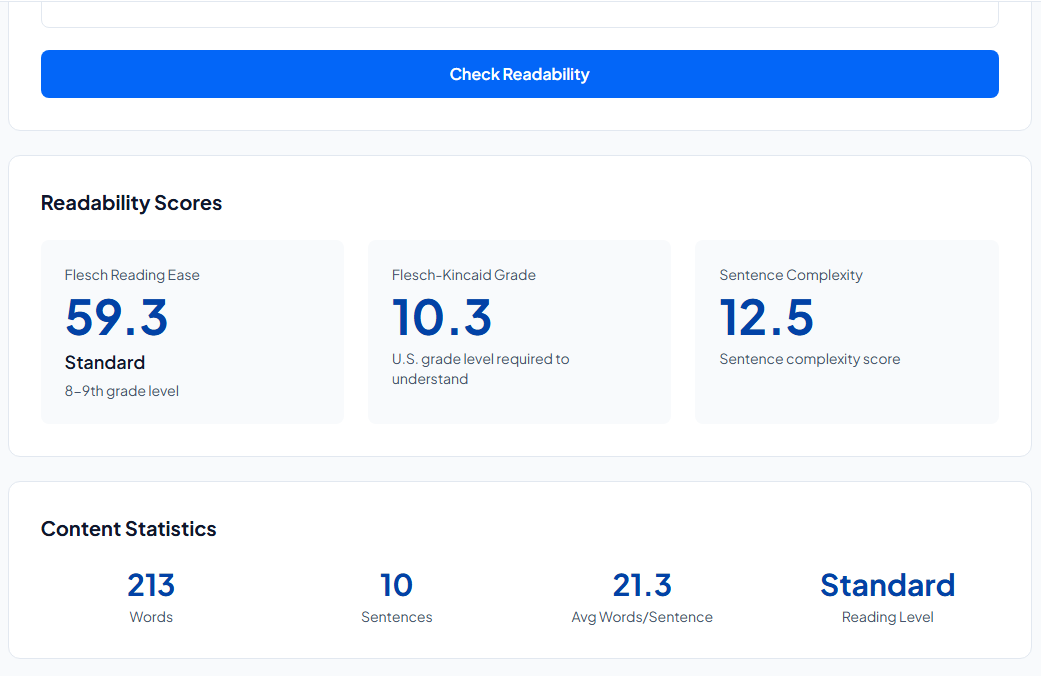
Example:
Key Features and Capabilities
Flesch Reading Ease and Grade Level, together: Both standard scores calculated in one pass, so you have both the 0–100 scale and the familiar US grade equivalent.
Supporting metrics included: Average sentence length, reading level, and total words, for anyone who wants the detail behind the entered content.
Rext AI Readability checker provides no length limit: Full articles process in a single pass.
Free and unauthenticated: No account, no card, unlimited use.