Introduction:
How to Use On-Page Optimization to Target Google Featured Snippets starts with making your content easier for both users and search engines to understand. The main goal is to focus on search intent by providing clear information, clear hierarchical headings, direct answers to readers' queries, useful tables, strong internal links, and well-organized supporting content. The goal isn't to force Google to show your page; the focus is to create the clearest answer for a query that already shows a featured snippet.
Google featured snippets: what they are and why they matter more than ever:
You know those highlighted boxes with the perfect answer to your entered query that appear right at the top of Google? Those are featured snippets, Google's way of serving up an instant answer.
A featured snippet may display a short paragraph, a numbered list, a bullet list, a table, or a video, depending on the type of information. Featured snippets matter because they can improve search visibility and place your content in a noticeable part of the search engine results page where users click the most, and you have a great chance of gaining organic traffic.
This position is often called position zero because the snippet can appear before the first traditional organic result.
Earning a position in Google’s featured snippet delivers these strategic advantages:
- More visibility in Google Search
- Greater authority around a topic
- More opportunities to attract qualified clicks
- Stronger brand recognition
- Better visibility for question-based searches
- Additional exposure in voice search and answer-based search experiences
However, featured snippet optimization is not simply about adding a keyword several times because Google looks at the overall relevance, quality, structure, and usefulness of the content.
A page or article must answer the search query clearly while also providing enough supporting information to show expertise on the topic. In many cases, pages that already rank well organically have a stronger chance of being selected because Google already sees them as relevant.
The most useful way to think about featured snippets is simple. Strong SEO helps your page enter the competition, while clear on-page optimization makes the answer easier to identify and extract.
The inner workings of Google's snippet selection process:
Google creates featured snippets automatically, so website owners cannot manually tell Google to display a specific paragraph, list, or table as a featured snippet. When a user searches for information, Google tries to understand the meaning and search intent behind the query; then it reviews relevant pages and may select a section that provides a clear and useful answer.
Imagine a user searches for the meaning of a featured snippet and one page explains the history of Google Search for several paragraphs before giving a definition. Another page has a clear heading followed immediately by a short and accurate explanation. The second page gives Google a much cleaner answer block to understand.
Search intent influences the snippet format
Different search queries often lead to different snippet formats because a definition question usually works well with a paragraph, a process often works better as a numbered list, and a comparison may be easier to understand in a table.
For example:
Search Query Type | Useful Snippet Format |
Definition | Short paragraph |
Step-by-step process | Numbered list |
Collection of ideas | Bullet list |
Comparison | Table |
Visual demonstration | Video |
Do not create a table because you want a table snippet instead; the format should suit the user's needs. Do not turn a simple definition into a long numbered process. The format should make the answer easier to understand.
Featured Snippets Can Change Over Time
There is a possibility that a page may earn a featured snippet and lose it later. This can happen even when the page is still ranking well because Google may choose another source. After all, the competing answer is clearer, more current, more relevant, or better matched to the search intent. The SERP layout may also change.
For this reason, featured snippet SEO should be treated as an ongoing optimization process rather than a one-time task.
How to Use On-Page Optimization to Target Google Featured Snippets
On-page optimization helps search engines to sort out the strongest answers that completely satisfy the user to read, scan, and understand the content.
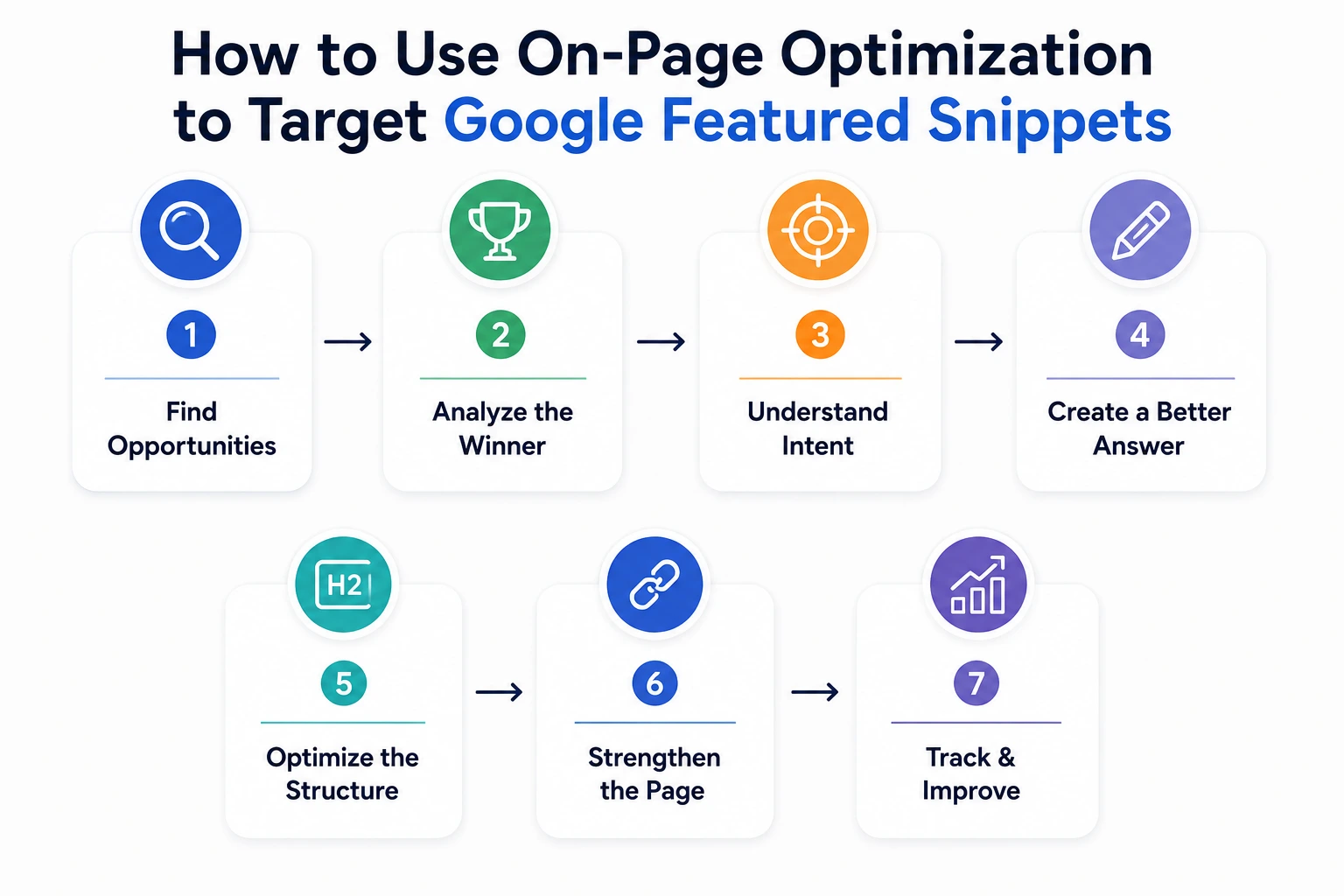
The best strategy is to start with queries where your page already has some organic visibility, like:
- Finding the Questions Google Already Answers with a Snippet.
- Identify pages that already rank for those queries.
- Study the current snippet format.
- Determine the exact search intent.
- Create or improve the answer on your page.
- Place the answer under a clear heading.
- Match the most useful format.
- Support the answer with deeper information.
- Improve internal linking and page structure.
- Track the results after publishing.
This approach is more effective than creating random snippet sections across a website.
Start with existing organic rankings
One of the most common mistakes is targeting snippets for keywords where the page has little or no ranking strength.
A better opportunity often exists on pages that already appear on page one. If a page ranks fourth, fifth, or sixth for a question-based keyword, Google already sees that page as relevant.
Improving the answer structure may give the page a better chance of earning the featured position. This is why existing rankings should guide your featured snippet opportunities.
Study the current winning result
Before editing your page, review the snippet Google currently shows.
Look at:
- The format
- The question being answered
- The length of the response
- The wording of the heading
- The amount of supporting detail
- The topics covered around the answer
Do not copy the competitor. Instead, understand why the answer may be useful.
Optimize the entire section
Do not focus only on one sentence. A strong answer block should provide a direct response first, then explain the topic in more detail.
Clear H2 or H3
Short direct answer in one paragraph. A second paragraph explaining why the answer matters. A list, example, or comparison that adds practical value.
This makes the content useful whether Google extracts only the first paragraph or a reader opens the full article.
Finding the best featured snippet:
The best featured snippet opportunities are usually queries where Google already displays a snippet, and your page already ranks reasonably well. This saves time because you are improving existing relevance rather than starting from zero.
Google Search Console is one of the most useful tools for this process. It can help you find queries that already bring impressions, clicks, and ranking visibility to your pages.
Review question-based queries
Start by looking for queries that include words such as:
- What
- How
- Why
- When
- Which
- Can
- Does
- Should
These queries often have strong informational intent. However, do not assume that every question produces a featured snippet. Search the query manually and check the current SERP.
Some searches may show People Also Ask, an AI Overview, a video result, or standard organic listings instead.
Build a simple opportunity list
A basic spreadsheet can make this process easier. Track information such as:
Data Point | Why It Matters |
Search query | Shows the exact keyword opportunity |
Current position | Helps you judge ranking strength |
Snippet owner | Shows who currently holds the result |
Snippet format | Helps determine the best content structure |
Target page | Shows which page should be improved |
Search intent | Helps you understand what the user wants |
Date updated | Helps measure changes later |
Result | Shows whether the optimization worked |
This prevents random changes and creates a clear optimization process.
Use competitor analysis carefully
Competitor research can reveal questions and topics your page has not answered. For example, a competing article may explain how to find snippet opportunities, while your article only explains what featured snippets are, and that gap reduces topical depth.
The goal is not to copy competitors; however, the goal is to understand the topic completely and identify information your readers still need.
Match search intent with the right featured snippet format
Understanding intent is important because a technically correct answer can still perform poorly if it uses the wrong format.
Featured snippets are most common for informational searches, but even informational queries can require very different answers.
Paragraph snippets
Paragraph snippets work well for definitions and short explanations. A good paragraph answer should be direct, clear, and easy to understand without reading the entire article.
Numbered list snippets
Numbered lists work best when steps must happen in order.
For example:
- Find a featured snippet opportunity.
- Review the current winning result.
- Identify the search intent.
- Improve the answer.
- Match the correct format.
- Publish the update.
- Track the result.
This format works because the sequence matters.
Bullet list snippets
Bullet lists work well when the items do not need to follow a specific order, like the benefits of featured snippets could include:
- Increased visibility
- Stronger authority
- Better brand recognition
- More opportunities for clicks
- Greater exposure in answer-based search
Table snippets
Tables work best for comparisons. If a user wants to compare several options, a table can present the information more clearly than a long paragraph.
For example:
Snippet Type | Best Use |
Paragraph | Definitions |
Numbered list | Processes |
Bullet list | Groups of related items |
Table | Comparisons |
Video | Visual demonstrations |
The format should always help the reader first. If the content is easier for a person to understand, it is usually easier for a search engine to interpret as well.
Optimize headings, direct answers, and content structure
A clear heading structure gives both users and search engines a map of your content. Your H1 should describe the overall topic of the page. H2 headings should cover major sections. H3 headings should explain supporting points within those sections.
Avoid using headings only because they contain keywords. A heading should tell the reader what they are about to learn.
Put the direct answer near the heading
One of the strongest on-page practices is to answer the question immediately after the relevant heading.
Do not make readers move through several paragraphs of background information before they receive the answer. For example, if the heading asks how long a featured snippet answer should be, the first paragraph should address length directly.
After that, you can explain the reasoning and provide practical guidance. A simple structure works well:
- Clear heading
- Direct answer
- Supporting explanation
- Example
- Additional advice
This format improves readability and creates a strong answer block, try our readability checker tool and find out your readability score.
Keep paragraphs focused
Long walls of text make information harder to scan; you must use short paragraphs with concise sentences that focus on one idea at a time. This does not mean every sentence should appear on its own line. The goal is to create natural groups of related ideas.
Use keywords naturally
Try to avoid repetition of the same phrase or the same keyword in every heading and paragraph because it can cause keyword cannibalization and your content is flagged. Search engines understand related languages.
For example, a page about featured snippets may naturally include terms such as:
- Snippet format
- Search intent
- Position zero
- Google snippets
- Content structure
- Answer block
- SERP features
- On page SEO
- Organic rankings
- Search visibility
These terms strengthen topical relevance without making the writing sound unnatural.
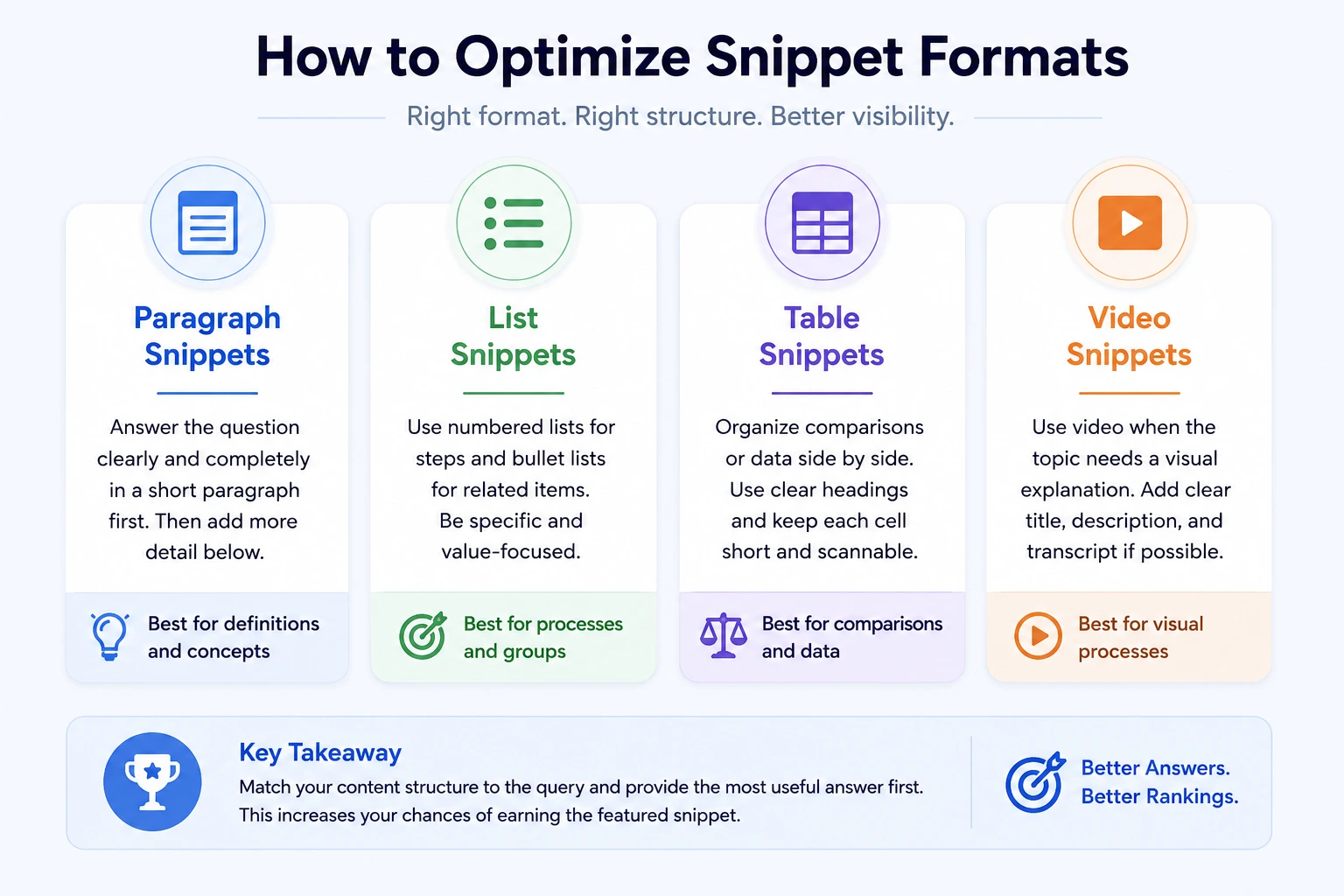
How to optimize paragraph, list, table, and video snippets
Different snippet formats need different content structures. Understanding these differences can help you create better answers.
Paragraph Featured Snippets
Paragraph snippets usually answer definition-style questions. A strong paragraph should answer the question quickly and completely. Avoid unnecessary introductions.
For example, if the user asks what featured snippet optimization is, explain the concept in a short paragraph first. Then provide deeper detail below. The answer should still make sense if Google displays it without the surrounding content.
List Featured Snippets
Use numbered lists for processes and bullet lists for groups of related items. A common mistake is writing vague list items.
Instead of writing:
- Improve content
- Fix SEO
- Add headings
Be more specific:
- Match the answer to search intent
- Add supporting examples after the answer and use a numbered list
Specific instructions provide more value to readers.
Table Featured Snippets
Tables should organize information that is easier to understand side by side. Use clear column headings and keep each cell concise. Avoid placing long paragraphs inside tables because this makes them harder to scan.
For example:
Factor | Weak Approach | Better Approach |
Heading | Vague topic label | Clear question or topic |
Answer | Long introduction first | Direct answer first |
Structure | One long paragraph | Short paragraphs and lists |
Keywords | Repeated exact phrases | Natural semantic terms |
Tracking | No measurement | Review rankings and impressions |
A table like this helps readers compare approaches quickly.
Video snippets
Video can be useful when the topic involves a visual process. Software tutorials, repairs, demonstrations, and step-by-step tasks may benefit from video content.
If video supports the page, use a clear title, useful description, accurate spoken explanations, and a written summary or transcript where helpful. Do not create video only to chase a SERP feature.
Using it when showing the process improves the user's understanding.
Use semantic HTML, internal linking, and supporting content
Semantic HTML helps define the structure and meaning of page content. Headings identify sections. Lists group related points. Tables organize comparisons. Paragraphs explain ideas.
Using the correct HTML structure improves accessibility and can make the content easier for search engines to understand.
Use proper heading structure
Do not use bold text as a replacement for a real heading. A large bold sentence may look like a heading to a reader, but proper H2 and H3 elements provide clearer structure in the HTML. Keep the hierarchy logical.
For example:
- H1 for the page topic
- H2 for main sections
- H3 for supporting topics
Avoid jumping randomly between heading levels.
Strengthen internal linking
To round out your snippet strategy, you'll want to explore these interconnected topics to strengthen internal linking:
- Keyword research – uncovering the exact questions people are asking.
- Search intent – understanding why they're asking those questions.
- On-page SEO – making sure your structure is snippet-friendly.
- Semantic SEO – covering topics in depth, not just keywords.
- AI search optimization – preparing for how search engines evolve.
- Google Search Console – tracking which queries already bring you visibility.
- Content optimization – fine-tuning every piece for maximum impact.
Add supporting content around the answer
A short answer alone is often not enough; readers sometimes need more explanation for understanding the topic.
If you mention that search intent affects snippet format, explain how.
If you mention Google Search Console, explain what data users should review.
If you mention structured data, explain what it can and cannot do.
This deeper support helps demonstrate expertise.
Schema markup can help search engines understand certain types of content, but there is no special schema that tells Google to place a page at position zero. The visible content remains the priority.
Clear answers, useful explanations, good structure, and strong relevance matter more than trying to use technical markup as a shortcut.
Track featured snippet performance with Google Search Console
Optimization without measurement is merely guesswork because the real power of optimization isn't in the changes you make, but in reality the data it tells you after those changes go live.
Google Search Console provides important metrics like impressions, click ctr, etc, and can help you review how a page performs before and after changes.
Search Console does not provide a simple report for every featured snippet your site owns, so you may also need manual SERP checks or a rank tracking tool.
Record a baseline before making changes
Before editing the page, record its current performance.
For example, note:
- Current ranking position
- Current snippet owner
- Monthly impressions
- Monthly clicks
- Click-through rate
- Target query
Then make the optimization.
Do not judge success only by winning the snippet
A featured snippet can improve visibility, but it does not always increase traffic. Some users may read the answer directly in Google and never click. This is common with zero-click searches.
For other queries, the snippet may attract more qualified visitors because users want deeper information. That is why you should also track business results when they apply.
Look at:
- Leads
- Signups
- Downloads
- Sales
- Contact form submissions
- Other conversions
The real goal is useful search visibility, not simply owning a special SERP feature.
Review lost snippets carefully
If your page loses a featured snippet, do not rewrite everything immediately.
First investigate what changed.
Ask:
- Did the snippet format change?
- Did another page provide a better answer?
- Did search intent change?
- Did your organic ranking fall?
- Is your information still current?
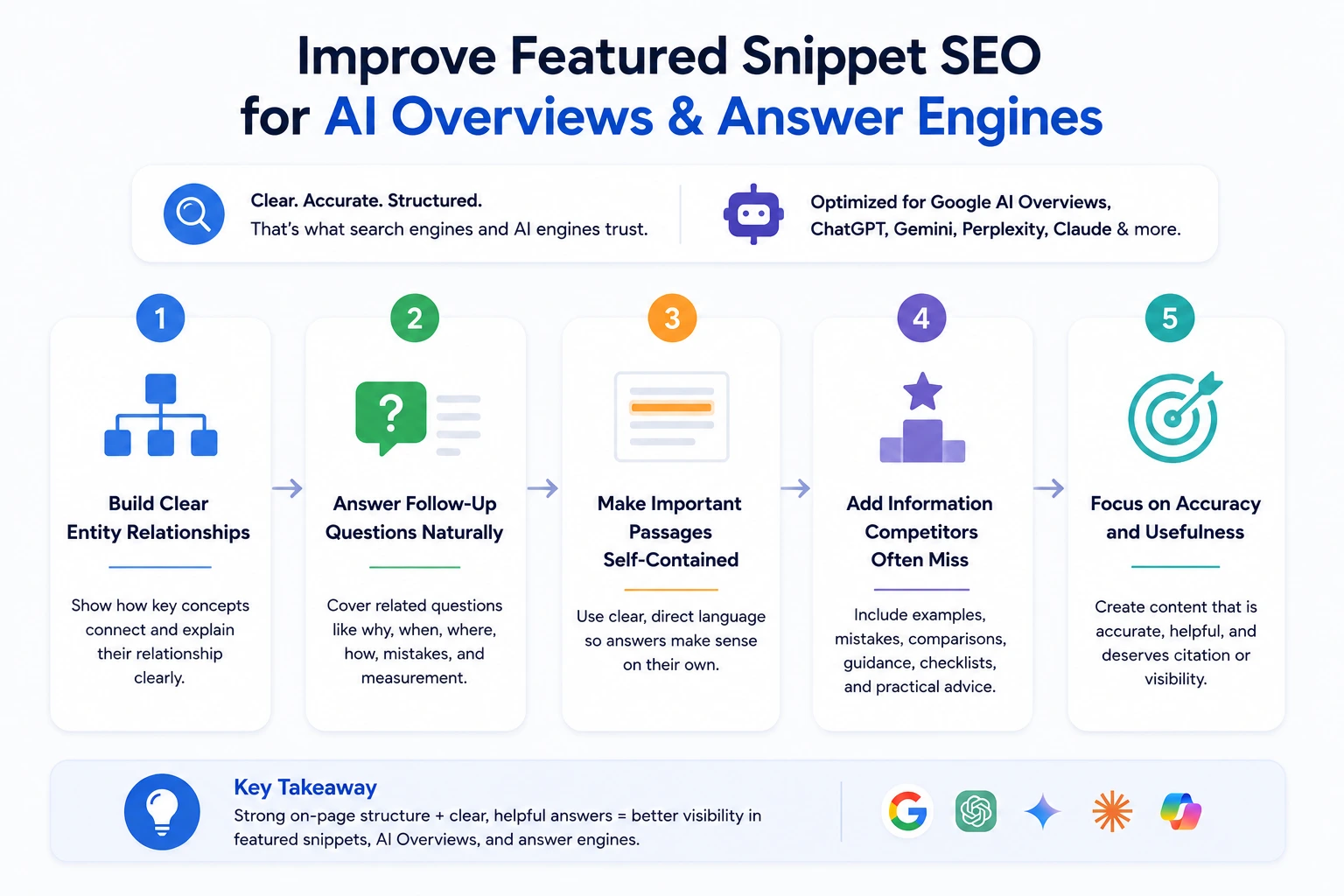
Improve featured snippet SEO for AI Overviews and answer engines
Featured snippets are now only one part of search visibility. Users also receive answers through Google AI Overviews and AI-powered tools such as ChatGPT, Gemini, Perplexity, Claude, and Copilot. The good news is that many strong SEO principles also support AEO and GEO. Clear information remains important.
Accurate explanations remain important. Logical structure remains important. The goal is to make your content easy for machines to interpret without making it unnatural for people.
Build clear entity relationships
A page should explain how important concepts connect. For example, do not simply mention search intent and snippet format in separate places.
Explain the relationship. Search intent helps determine which snippet format best answers the query. Do not simply mention Google Search Console.
Explain that it can help you measure queries, impressions, clicks, and average rankings before and after optimization. These clear relationships improve semantic relevance.
Answer follow-up questions naturally
AI search systems often combine information from several parts of a source. This means your page should answer likely follow-up questions.
For example, after explaining how to optimize a paragraph snippet, you might also explain:
- When a paragraph format is appropriate
- How long the answer should be
- Where to place the answer
- What mistakes to avoid
- How to measure the result
This creates topical depth.
Make important passages self-contained
A useful answer should still make sense and avoid vague phrases such as "this method" when the reader may not know what the phrase refers to. Use clear nouns and direct language.
Find strong opportunities for better answers by understanding search intent, answering questions clearly, matching the right content format, and supporting each answer with useful detail. Good on-page structure can make your content easier for Google and other answer engines to understand while also making the page more helpful for people.
Add information that competitors often miss
Generic content is easy to replace. Strong content usually adds practical value. Useful additions may include:
- Realistic examples
- Common mistakes
- Decision-making guidance
- Clear comparisons
- Updated recommendations
- Measurement advice
- Practical checklists
- Balanced explanations
Rext AI applies the same structure: its outline plans H2 and H3 headings and a snippet target for each section, and each claim links its source. The goal should never be to trick an answer engine.
The goal is to publish content that is accurate, easy to understand, and genuinely useful enough to deserve citation or visibility.
Frequently asked questions
What is the best way to optimize for featured snippets?
Featured snippet optimization works best when the content closely matches search intent and presents the answer in a clear, easy-to-extract format. A strong approach is to place a concise answer directly below a relevant H2 or H3 heading, then support it with additional context, examples, or practical guidance.
Numbered lists and bullet points help the data be structured, but the main focus should remain on clarity, structure, and usefulness rather than keyword repetition, because well-organized content is easier for both users and search engines to understand.
Do Featured Snippets Reduce Website Traffic?
Featured snippets can answer simple questions directly in the search results, so some users may get what they need without visiting the source page. However, they can also increase visibility, attract attention above traditional organic listings, and generate strong click-through rates when users need more detail. The best approach is to provide a clear answer in the snippet while offering deeper information, examples, tools, or expert guidance on the page that gives users a reason to continue reading.
Is It Still Worth Optimizing a Website for Google Search?
Yes. Search optimization remains valuable, especially when organic search is an important source of website traffic. The focus should be on creating simple, crawlable pages with clear headings, readable content, and useful information rather than trying to manipulate rankings. A website should also provide more value than a short search result can deliver, such as detailed explanations, original insights, services, tools, or resources that encourage users to visit the full page.
Does schema markup help you get featured snippets?
Schema markup does not guarantee a featured snippet; however, structured data can help search engines understand specific types of information, but Google does not provide a special featured snippet schema that automatically earns position zero. Focus first on visible content.
Search intent, answer quality, strong organic relevance, and clear page structure are more important than treating schema as a shortcut.
What Content Optimization Techniques Can Improve Organic Traffic?
Focus on search intent, answer the main question early, improve content depth, strengthen internal links, and refresh titles and meta descriptions. Google Search Console can also reveal useful queries to target within existing pages.
In Rext AI On-page SEO
About the Author

Sania Usman
Sania is a technical writer at Rext AI with five years of experience in writing for SaaS products and technical writing. She joined Rext AI to make technical content clear without oversimplifying it. Sania specializes in topic clusters, on-page optimization, SaaS articles, and content that answers the questions people are actually searching for.