
How Small Businesses Can Use Schema Markup to Get More Customers
How Small Businesses Can Use Schema Markup to Get More Customers comes down to one simple idea: make your business information easier for search engines and other systems to understand.
Schema markup adds structured data to your website. It can explain what your company does, which services or products you offer, who created an article, when your business is open, and how different pages connect.
Schema does not guarantee higher rankings. It also does not guarantee a rich result. What it can do is give search systems clearer information about your content. That can support stronger search visibility, more useful search appearances, better-informed visitors, and more chances to earn qualified leads.
The best results come when the schema supports accurate, helpful content. It should never replace strong pages, useful information, or a clear SEO strategy.
Why Schema Markup Matters for Small Business Websites
Small business websites often contain useful information that is easy for people to understand. A visitor can look at a page and quickly see the company name, services, phone number, prices, reviews, opening hours, or product information.
Search engines have a different job. They need to identify what each piece of information means and how it connects with the rest of the website. Structured data gives search engines extra context. It helps explain the meaning behind information that may otherwise look like normal text or numbers on a page.
How Search Engines Read Business Information
Search engines crawl website content, links, images, headings, metadata, and other signals to understand a page. Schema markup adds another layer of meaning to that information.
For example, a number shown in a website header could mean many things. Structured data can make it clear that the number is the business telephone number.
The same idea applies to:
- Business name
- Website URL
- Services
- Products
- Opening hours
- Articles
- Reviews
- Brand identity
- Contact information
This creates machine-readable information that can make a page easier to classify and understand.
When business information is clear and consistent, search engines have a better chance of connecting the page with the correct entity, topic, service, or product.
Why Clear Website Data Can Support Customer Discovery
Clear information can help search systems connect a page with relevant customer queries. Imagine a business that offers three services, but the website describes them in vague language. Search engines may have to work harder to understand what the company actually provides.
Now imagine that the same business has clear service pages, useful headings, accurate business information, strong internal links, and relevant structured data. The picture becomes much clearer. Schema markup alone will not create demand or rankings. However, when it supports a well-built website, it can strengthen search engine understanding and reduce confusion.
For a small business, that matters because better understanding can create more opportunities for customer discovery and qualified organic traffic.
What Is Schema Markup and How Does It Work?
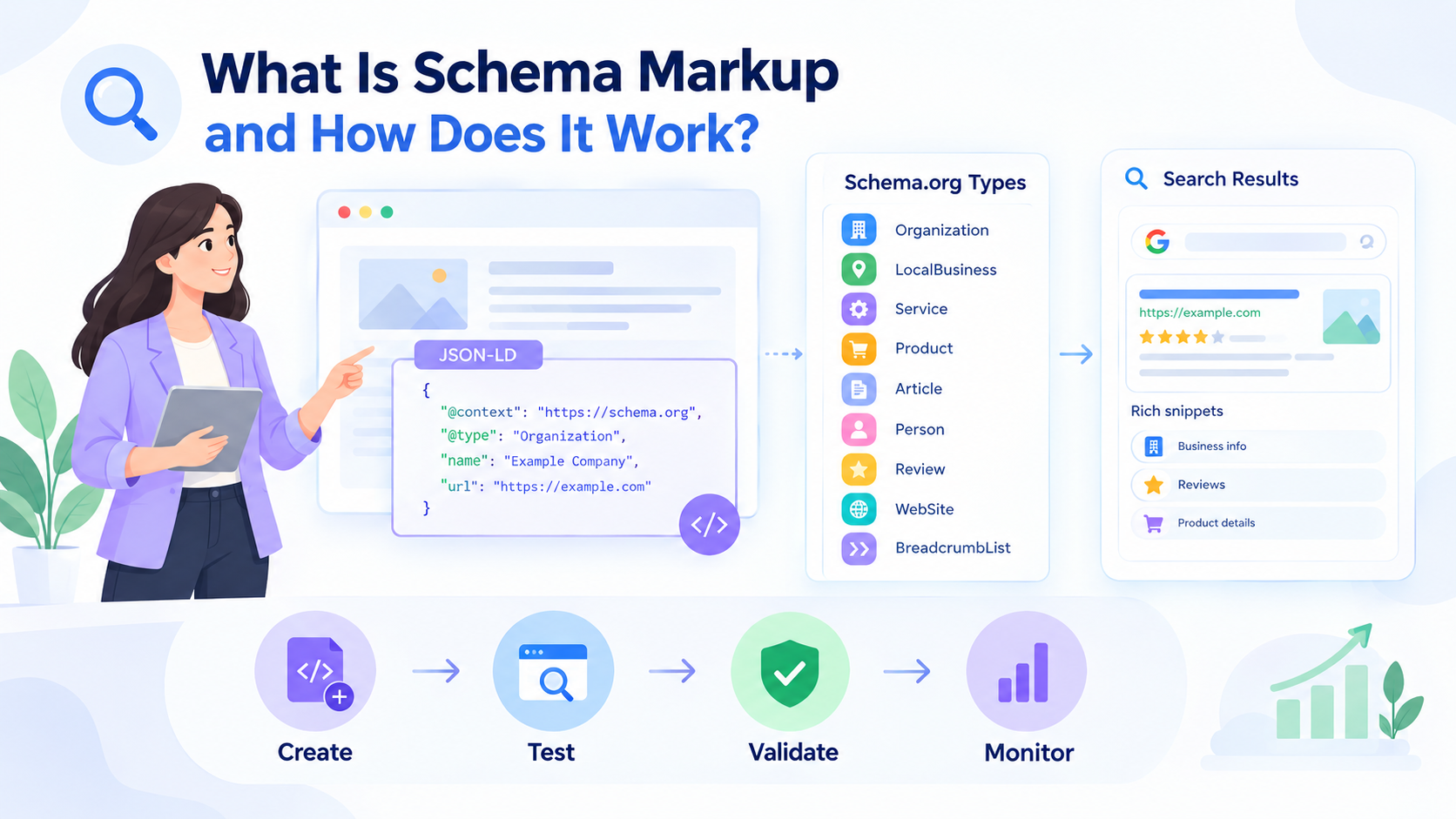
Schema markup is code that describes information already found on a web page.
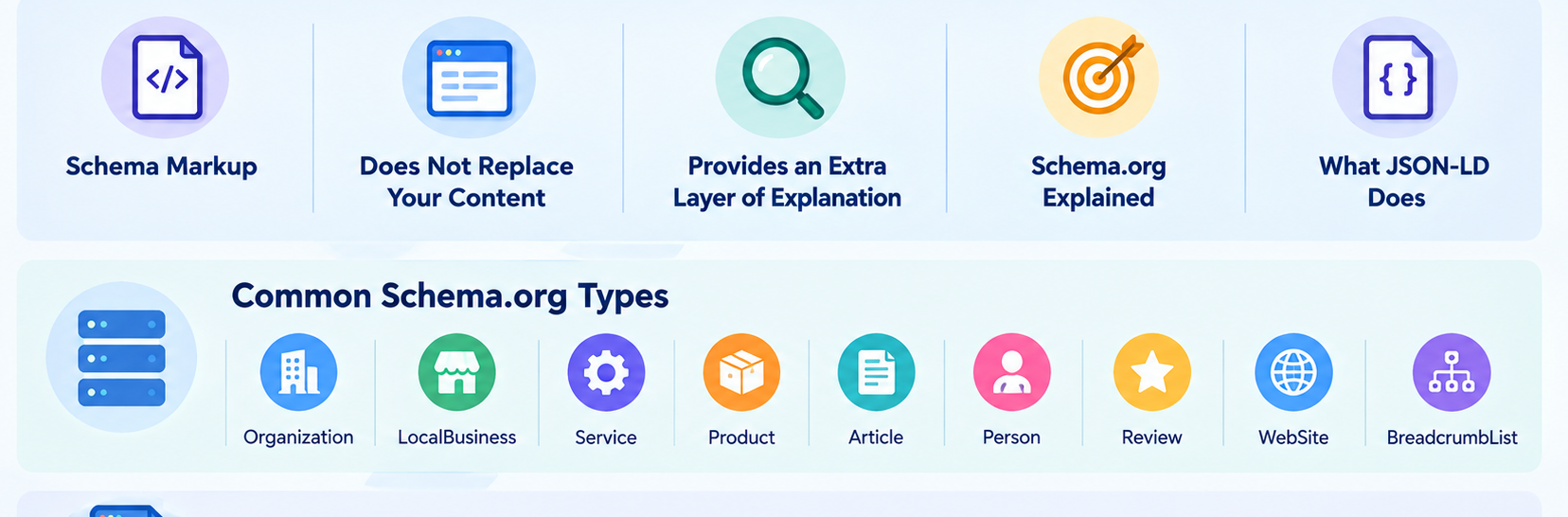
It does not replace your visible content. Instead, it gives search engines a more structured way to understand what that content means.
Think of it as an extra layer of explanation for machines.
Schema.org Explained in Simple Terms
Schema.org is a shared vocabulary used to describe things on the web.
You can think of it as a dictionary for website entities. It gives websites a standard way to describe businesses, services, products, articles, reviews, and other important information.
Common Schema.org types include:
- Organization
- LocalBusiness
- Service
- Product
- Article
- Person
- Review
- WebSite
- BreadcrumbList
Each type can include different properties.
An Organization, for example, can have a name, URL, logo, contact details, and links to official profiles. A Product can include information about an item, while an Article can include the headline, author, and publication date.
These properties help connect facts into a clearer business identity.
What JSON-LD Does
JSON-LD is one of the most common ways to add structured data to a website.
Instead of mixing schema throughout the visible HTML, JSON LD can place structured information inside a separate block of code. This often makes it easier to create, update, and manage.
A simple example may look like this:
{
"@context": "https://schema.org",
"@type": "Organization",
"name": "Example Company",
"url": "https://example.com"
}
The goal is not to make your website look more technical.
The goal is to provide search engines with clean, structured facts about the page and the business behind it.
Schema Markup vs. the Content Visitors See
The visible page is for the visitor. Schema describes that page for machines.
The two should agree.
If your schema says you offer a service that the page never mentions, that creates a mismatch. If your markup lists different business hours from the visible website, that creates another inconsistency.
A useful rule is simple:
Mark up information that is real, accurate, and supported by the page.
Structured data works best when it describes content rather than trying to create information that visitors cannot see.
How Schema Markup Can Help Turn Search Visibility Into Customers
Small businesses usually do not care about structured data because the code itself is interesting. They care about what happens after someone finds their website.
The more useful question is how clearer structured information can support customer acquisition.
Help Search Engines Understand What You Offer
Service names can sometimes be unclear.
A page may use industry language, brand terms, or creative headlines that make sense to customers but provide less context to search engines.
Clear content combined with Service schema, Organization schema, Product schema, or LocalBusiness schema can help define the entities involved.
This creates a clearer relationship between:
your business, your offer, the page, and the search query
This does not force a search engine to rank the page. It simply provides better context.
When the content and structured data support each other, search systems can build a clearer understanding of what the page represents.
Make Search Results More Useful to Potential Customers
Some supported structured data can make pages eligible for richer search appearances.
Depending on the page type and search feature, users may see extra information before they click. This can make search results more useful and help the searcher decide whether the page fits what they need.
A richer search appearance is not guaranteed. Search engines still decide when and how to show enhanced results. The goal should not be to chase every possible search feature. The goal should be to provide accurate information that makes the page easier to understand.
Attract More Relevant Organic Visitors
More traffic is not always better because a small business needs visitors who are actually interested in its services or products. If structured business information helps search systems better understand exactly what a page covers, that can support stronger contextual relevance.
A visitor who already understands the service, product, or topic before clicking may be more qualified than someone who lands on the page by accident. This is where search visibility connects with customer intent.
Turn Better Informed Visitors Into Leads
A visitor still needs a useful page after the click.
Schema cannot fix a confusing website, a weak offer, or poor content. The page must make the next step clear.
That may include:
- Calling the business
- Completing a form
- Booking an appointment
- Requesting a quote
- Buying a product
- Reading another helpful page
Schema can support the path that begins with search engine understanding and ends with a real customer action.
Which Schema Types Matter Most for Small Businesses?
Small businesses do not need to add every schema type they can find.
The better approach is to choose markup that matches the real purpose of each page.
Organization Schema for Business Identity
Organization schema helps define the company itself.
Useful properties may include:
- Name
- URL
- Logo or image
- Contact information
- Official profiles through sameAs
- A stable @id
This can help create a consistent business identity across the website.
Organization schema is especially useful when the company is the main entity behind many pages, products, services, and articles.
Service Schema for Service Pages
Service schema can describe a service offered by a business.
A strong service page should still do most of the work. It needs to explain what the service is, who it is for, what problem it solves, what is included, and how the visitor can take the next step.
The structured data can then reinforce that information.
Service schema should not be treated as a shortcut to rankings or special search results. Its main value is helping describe the service as a clear entity within your website data.
Product Schema for Businesses Selling Products
Product schema is useful when a page focuses on a specific product.
Depending on the page and search requirements, Product markup may contain information such as:
- Product name
- Description
- Image
- Price
- Availability
- Reviews
- Ratings
The information in the markup should match what customers can actually see on the page.
Do not use Product schema on a page that does not represent a real product.
LocalBusiness Schema for Businesses Serving Local Customers
LocalBusiness schema is useful when a company has business information such as opening hours, contact details, a physical presence, business category, or service area.
Using the most accurate business type can provide better context than using a generic label when a more specific option exists.
This can help clarify business information without turning the entire SEO strategy into local SEO.
For many businesses, LocalBusiness schema is one part of a wider structured data strategy.
Article and Blog Schema for Educational Content
Educational content can also benefit from structured data.
Article, BlogPosting, or another suitable subtype can describe details such as:
- Headline
- Author
- Images
- Publication date
- Modification date
This creates a clearer relationship between the business, its content, and the person or organization responsible for publishing it.
For small businesses using helpful content to answer customer questions, article related schema can support a stronger content structure.
Bread crumb List and WebSite Schema
BreadcrumbList markup helps describe where a page sits within a website structure.
For example, a page may sit within:
Home → Services → Service Name
This relationship can make site structure easier for search systems to understand.
WebSite schema can help define the website itself.
These supporting types may not feel as important as Product or LocalBusiness markup, but a clear site structure matters. The goal is to create consistent entity relationships instead of adding random schema types to unrelated pages.
How to Match Schema Markup to the Right Page
Good schema markup implementation starts with one simple question:
What is this page really about?
The answer should guide the schema type.
Homepage Schema
The homepage usually represents the main business or brand.
Organization schema often makes sense here because it can define the company and connect important business details.
For businesses where LocalBusiness is the more accurate main entity, the appropriate LocalBusiness subtype may fit better.
The important point is that the visible homepage should support the information found in the markup.
Service Page Schema
A service page should focus on one real service.
Service schema can reinforce that relationship.
Avoid adding ten services to a page that only explains one. Specific markup is easier to understand than a large block of unrelated structured information.
A strong service page should also include helpful written content that explains the service clearly.
Product Page Schema
Use Product schema when the page is actually about a specific product.
The structured data should match visible details such as the product name, offer information, availability, ratings, or reviews when those properties apply.
Do not place product information in schema that customers cannot find on the page.
Blog Post Schema
A blog post can use Article or BlogPosting markup.
The author, headline, image, publication information, and other details should reflect the real article.
This creates a stronger relationship between the business, its content, and the author or publisher.
Location and Contact Pages
A contact or business information page may contain useful details such as a phone number, opening hours, contact options, service area, and business address when applicable.
That information should remain consistent with the rest of the website.
Do not create several conflicting versions of the same business identity across different pages.
How Service Businesses Can Use LocalBusiness Schema for Local SEO
Local SEO matters for companies that rely on customers searching for nearby services or service providers.
Structured data can support this strategy, but it should work alongside accurate website content, business listings, and a well-managed Google Business Profile.
Add Accurate Business Information
LocalBusiness structured data can include useful information such as:
- Business name
- Telephone
- Website URL
- Address when applicable
- Opening hours
- Business category
- Service area
- Geographic information
Accuracy matters more than filling every possible field.
It is better to provide a smaller amount of correct information than a large amount of outdated or misleading data.
Keep Schema and Google Business Profile Information Consistent
NAP consistency refers to the business name, address, and phone information remaining consistent across important sources.
The website should not show one phone number while the Google Business Profile shows another.
Business hours should also remain accurate.
The same principle applies to local citations, online directories, and other official profiles.
Consistent data creates fewer questions about which version of the business information is correct.
Use Service Schema Alongside Business Information
A useful structured data model can connect the business with its services.
Instead of treating every page as a separate object with no relationship, think in terms of connected entities.
For example:
Business → Service → Service Page
This relationship is useful for semantic SEO because it clearly connects who the business is with what it provides.
Local business schema markup can therefore support local search visibility while Service schema provides more detail about specific offerings.
How Structured Data Fits Into SEO Content Optimization
Structured data works best when it supports strong content.
It should be part of a larger SEO strategy rather than treated as a separate trick.
Schema Does Not Replace Good Content
A weak page is still a weak page after a schema is added.
If the content does not answer the visitor's question, explain the service, or satisfy search intent, structured data will not fix that problem.
The same applies to thin product pages, vague service descriptions, or blog posts that do not answer the main question.
Start with the page itself.
Then add schema.
Search Intent and Page Quality Still Come First
Search intent tells you what the user hopes to find.
A customer searching for a service may want pricing, benefits, examples, a process, trust information, or an easy way to contact the company.
Someone reading an educational article may want a direct answer followed by clear guidance.
Your content needs to satisfy that need first.
Schema simply describes the page in a structured way.
Use Schema to Clarify Content, Not Rescue Weak Content
One common mistake is treating technical SEO as a substitute for page quality.
A business may add Organization, Service, Article, and other structured data while ignoring thin content, unclear headings, weak internal links, or poor navigation.
That approach puts the technical layer before the user.
Build a useful page first.
Then use structured data to clarify its meaning.
Connect Schema With On Page SEO
A strong page often combines several elements:
- Clear search intent
- Useful H1, H2, and H3 structure
- Helpful copy
- Natural internal links
- Accurate metadata
- Relevant entities
- Structured data
- Clear calls to action
These signals should tell the same story.
When the title says one thing, the content says another, and the schema says something else, the page becomes less clear.
Good on page SEO creates consistency.
How Schema Markup Supports AI Search and Answer Engines
Search is no longer limited to a traditional list of links.
People also ask questions through AI search experiences, conversational systems, and answer engines.
This makes clear entity information important, but it does not mean structured data guarantees AI visibility.
How Structured Data Defines Entities and Relationships
Structured data can describe relationships between real things.
For example:
Organization → Service → Website
Another relationship may look like:
Business → Article → Author
These connections can make a website easier for machines to interpret.
Properties such as @type, @id, sameAs, and areaServed can help define identity and relationships when used correctly.
This is one reason entity optimization has become an important part of semantic SEO.
Schema Markup and Answer Engine Optimization
Answer Engine Optimization, or AEO, focuses on making information easier for systems to understand and use when answering questions.
Schema can support that goal by making facts clearer.
However, AEO still depends heavily on visible content.
Useful content should provide:
- Direct answers
- Clear definitions
- Strong headings
- Supporting context
- Accurate facts
- Natural language
- Helpful examples
Structured data should reinforce those things rather than replace them.
Can Schema Help With Google AI Overviews and AI Search?
Schema can make some information easier for machines to interpret.
That does not mean a page will automatically appear in Google AI Overviews, ChatGPT, Gemini, Perplexity, or another AI-powered search experience.
No schema property guarantees an AI citation.
A better approach combines:
- Helpful content
- Clear entity information
- Accurate structured data
- Strong topical coverage
- Trustworthy information
- Good site architecture
That gives search engines and AI systems a clearer website to understand.
Why Visible Content Still Matters Most
Do not hide important information only inside schema.
If a service matters, explain it on the page.
If an author matters, show the author.
If business hours are important, display them where users can find them.
Structured data should describe real content.
That makes the page more useful to visitors and easier for machines to understand.
How to Create and Add JSON-LD Schema Without Coding
You do not need to become a programmer to start using structured data.
Schema generators, content management systems, and SEO tools can handle much of the technical work.
Step 1, Choose the Correct Schema Type
Start by looking at the page.
Ask what it represents.
Is it:
- A company
- A service
- A product
- A local business
- An article
Choose the schema type that most closely describes the real content.
Step 2, Enter Information That Actually Appears on the Page
Do not use a schema generator as a place to add extra marketing claims.
Enter accurate information that users can verify from the website.
That may include:
- Business name
- Website URL
- Service name
- Description
- Phone number
- Image
- Article author
- Product details
Keep the structured data aligned with visible content.
Step 3: Generate the JSON-LD
You can create JSON-LD manually, through a schema plugin, or with a schema generator.
For businesses that want a simpler workflow, Rext AI provides a Schema Markup Generator that can help create ready-to-use JSON-LD without requiring users to write all of the code from scratch.
A tool can save time, but you should still review the final output.
Automation can speed up schema markup implementation. It should not replace accuracy.
Step 4: Add the Markup to Your Website
How you add the code depends on your website platform.
Common options include:
- Theme settings
- SEO plugins
- Custom code areas
- CMS fields
- Developer templates
The important part is making sure search engine crawlers can access the page and its structured data.
Step 5, Test It Before Publishing
Never assume generated code is correct.
Run it through the proper testing tools.
Check for:
- Syntax errors
- Missing required properties
- Wrong entity types
- Incorrect URLs
- Old business information
- Important warnings
Testing should be part of implementation, not an optional final step.
How to Test Schema Markup and Avoid Costly Mistakes
Even simple structured data can go wrong.
A small typo, incorrect type, old phone number, or inaccurate property can create conflicting business information.
Validate Your Structured Data Before Publishing
Schema validation checks whether your markup follows the expected structure.
It can reveal errors before search systems process the page.
Validation does not prove that the page will rank higher or receive a rich result.
It simply helps confirm that the structured data can be read correctly.
Use Google Rich Results Test
Google Rich Results Test can help you check structured data related to supported Google Search features.
The tool can identify errors and warnings that may need attention.
A successful result is useful, but it should not be mistaken for a guarantee that Google will display a rich result.
Think of it as a technical check.
Check Schema.org Markup With Schema Markup Validator
The Schema Markup Validator can help check Schema.org vocabulary more broadly.
This matters because not every valid Schema.org type has a special Google rich result.
A schema type may still provide useful machine readable context even when it does not create a special search appearance.
Watch Google Search Console for Structured Data Issues
Google Search Console can help website owners identify structured data issues for supported search features.
It can also help monitor broader search performance, including:
- Impressions
- Queries
- Clicks
- Page performance
- Search appearance data
This makes it useful both during setup and after publishing.
Keep Schema Updated When Content Changes
Structured data can become outdated.
Business hours change. Services change. URLs change. Products sell out. Articles get updated.
When visible information changes, review the related schema too.
A structured data audit should be part of normal website maintenance.
How to Measure Whether Schema Is Helping You Get More Customers
Schema is useful only when it supports real business goals.
Do not stop measuring at "valid markup."
Look at what happens after implementation.
Search Impressions and Organic Clicks
Start with Google Search Console.
Watch whether important pages gain or lose impressions and organic clicks over time.
Do not assume every change comes from schema.
SEO performance can change because of content, competitors, search demand, links, technical issues, algorithm changes, and many other factors.
Use longer trends rather than judging the result from a few days of data.
Click-Through Rate
Click-through rate tells you how often people click after seeing your page in search.
A more informative search appearance may help people understand a page before visiting it.
Many factors can affect click-through rate, including:
- Page title
- Description
- Search intent
- Brand recognition
- Competitors
- Search features
Look at the full result rather than one metric alone.
Qualified Organic Traffic
Raw traffic numbers can look impressive while producing very little business value.
Ask whether organic visitors are reaching the right pages.
Are they reading service pages? Are they viewing products? Are they moving from educational content into commercial pages?
Qualified organic traffic matters more than traffic with no intent.
Leads, Forms, Calls, and Purchases
This is where SEO connects with revenue.
Track meaningful actions such as:
- Contact forms
- Calls
- Purchases
- Quote requests
- Appointment requests
- Trial signups
If search visibility rises but conversions remain flat, the issue may be the page experience, the offer, or the call to action rather than the structured data.
Search Appearance and Rich Result Performance
Where supported, watch how pages appear in search and whether relevant search features are being detected.
Valid markup does not guarantee a special search result.
Treat rich results as an opportunity rather than an entitlement.
The main goal is still helping searchers understand your page and attracting the right visitors.
What Schema Cannot Tell You by Itself
A valid schema test cannot tell you whether customers trust your business.
It cannot tell you whether the offer is competitive.
It cannot tell you whether the landing page converts well.
It also cannot prove that a ranking change happened because of structured data.
Measure the full customer path:
visibility → click → page experience → lead → customer
That is a much more useful business measurement than simply counting how many schema types are installed.
Frequently Asked Questions
Does schema markup directly improve Google rankings?
Not directly. Schema markup helps search engines understand your page and may support eligible search features. Strong rankings still depend on helpful content, technical SEO, relevance, authority, and user experience.
What schema type should a small business use?
It depends on the page.
Organization schema can define the company. LocalBusiness can describe a local business. Service and Product schema can describe specific offers, while Article or BlogPosting can fit educational content.
Can I add schema markup without knowing how to code?
Yes. You can use schema generators, CMS tools, or plugins to create JSON-LD. Always review the output and test it before publishing. More complex setups may still need a developer.
Does every page on a website need the same schema markup?
No. Different pages have different purposes, so their structured data should match the content. A homepage, service page, product page, and article should not all use the same markup.
Can schema markup help my website appear in AI search results?
It can help AI systems understand your business and content more clearly. However, schema does not guarantee a mention or citation in AI search. Content quality, relevance, authority, and entity clarity still matter.
About the Author
Muhammad Usman
Muhammad Usman is an SEO writer at Rext AI, with five years of experience helping SaaS brands to grow organic traffic. He combines keyword research with genuine subject knowledge, so his content performs well without reading like it was written for a search algorithm. Usman has a particular interest in search intent and how it shapes content strategy. He writes for readers first and search engines second.