An AI article writer is a professional drafting and editing engine that predicts the article or content type based on your requirements after searching the whole internet, and acts as your AI writing assistant. Picking the right AI article writer that can work according to your requirements can feel like a daunting task because the market is flooded with AI writing assistant tools, but not every tool works under our supervision. I am providing information on how these tools perform, where they fall short, and what to check before you commit to a subscription.
Table of contents:
- Best AI Article Writer Guide 2026
- What they’re good at:
- What they’re bad at (and how they get you in trouble):
- Hallucinations and "confident nonsense":
- Generic content by default:
- Tone drift:
- Step-by-step Guide before buying any AI writing assistant tool:
- Key benefits of using AI article writers:
- Choosing The Right AI Article Writer
- Features to Look For in an AI Article Writer
- Pricing considerations
- Frequently asked questions
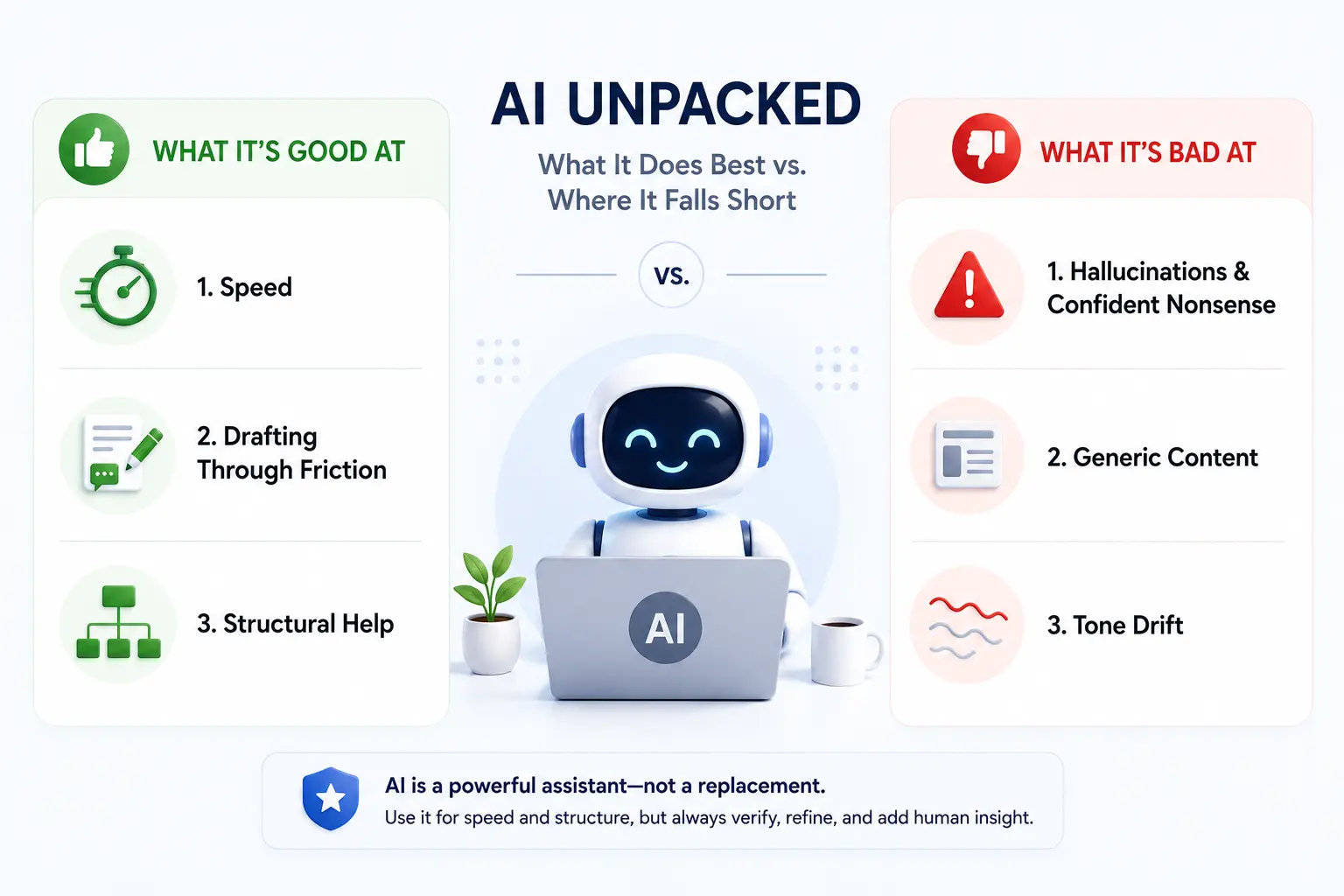
What they’re good at:
1- Speed:
If you have a decent brief and you’re willing to iterate, AI can be your fast writing assistant in content creation. What I see when someone has a clean workflow: outline → draft → tighten → fact-check.
2- Drafting through friction
The biggest productivity win isn’t that the AI writes better than you. It’s never tired and never slows down like humans and never makes mistakes like humans do.
3- Structural help:
Most people judge AI on sentence quality. I judge it on whether it can:
- Create a clean and structured outline that conveys the intent or not
- Maintain a point of view across sections
- Avoid contradictory claims that look real but in reality are not
- Keep headings aligned with the tone and search intent
What they’re bad at (and how they get you in trouble):
Hallucinations and "confident nonsense":
Most AI article writers will happily invent a statistic or a study and highlight it confidently as truth, but it’s not because AI can’t process information as humans do. Rext AI lowers that risk: it searches the web before it writes, links each claim to its source and lists any claim without one under Claims to verify, so read those before you publish.
Generic content by default:
If your prompt is broad (“Write an article about email marketing”), the output is broad. Sometimes, AI will add unnecessary information just to complete the word count you provided and to make the content readable. Where Rext AI stands out is in how it builds each outline from your keyword and what already ranks for it, and lets you edit it before anything is written, rather than handing you a one-size-fits-all template.
Tone drift:
A common complaint with AI article writers is that they want to sound like humans, but just for two or three paragraphs, then quietly shift their tone to a generic promotional tone. Rext AI writes in your persona’s tone, guided by your brand voice profile, then edits once for rhythm and readability.
Step-by-step Guide before buying any AI writing assistant tool:
Here’s a practical, step-by-step way to “understand” a tool before you buy it.
If you do only one thing, do this 30-minute test on any AI article writer:
- Give it a real brief you’ve used before (not a made-up one).
- What must be included,
- What must not be included,
- Your preferred tone.
- Ask for an outline first. Don’t let it draft immediately. An outline provides you with a clear answer on what is going to be included and what’s not. You can simply reject that automatically generated outline and provide more instructions about what you want to be included.
- Review the generated outline and compare it with your requirements.
- Force a rewrite with constraints (“cut 30%, keep the same meaning,” “make it more direct,” “remove hype,” “add a real example scenario”).
- Check whether it follows instructions without fighting you.
Key benefits of using AI article writers:
- Efficiency:
AI writers can produce content significantly faster than a human writer can.
- Quality improvement:
Many writing tools help with grammar, structure, tone, and readability, which can make an average draft easier to understand, especially if you’re not a native speaker or you’re writing outside your comfort zone.
- Cost-effective access:
Some tools are easy to try without paying. They offer a free demo or a free trial with limited daily or monthly usage based on their workflow.
That last point matters more than most people admit: the only “best” tool is the one that survives contact with your actual workflow.
Choosing The Right AI Article Writer
Choosing the right AI writing assistant tool depends on what you’re writing, how often, and what “done” looks like for you.
If you publish casual blog posts, your requirements are different from those of if you’re producing regulated healthcare content, academic work, or client deliverables that get reviewed line-by-line.
1. User-friendly interface
A clean, intuitive interface is crucial, especially for beginners, but here’s my opinionated take: interface matters less than interaction because a clunky UI turns every revision into a restart.
A common mistake I see is that people choose the tool with the prettiest interface, then realize it is just pretty and can’t handle the actual tasks, like maintaining a consistent brand voice across a 10-post cluster.
2. Quality of output (what “quality” really means)
Quality includes:
- correct structure,
- accurate claims,
- consistent voice,
- minimal repetition,
- Clean transitions that don’t feel stapled together.
Try to use those AI writing assistant tools capable of creating content that meets SEO needs and is E-E-A-T-optimized without sacrificing readability.
3. Versatility and range of features:
Different content types have different needs; for blogs, you want outlines, headings, expansions, and consistency across sections. For landing pages and social media posts, the content structure and requirements are different, so the best tool knows how to write differently for different kinds of content.
4. Pricing models:
Don’t just compare price tags for buying different AI article-writing tools. Compare:
- How many articles can you realistically produce under the limit,
- whether team access costs extra,
- Whether the “good” features are locked behind higher tiers.
I’ve watched freelancers buy premium plans for the best AI article writer, use it heavily for two weeks, then barely touch it once they realize the content they produced isn't what they need. Trial periods are your friend.
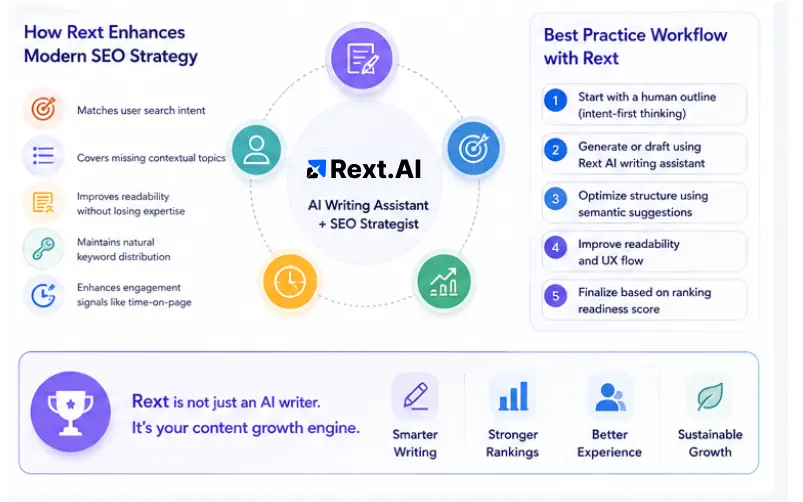
Unlike most AI article writers, Rext AI brings keyword Analysis, outline generation, writing, SEO optimization, EEAT optimization, and WordPress publishing all into one connected workflow.
Features to Look For in an AI Article Writer
This is where most AI article-writing guides get fluffy. They list 20 features. Half of them don’t matter. Here are the exact writing features that actually change your day-to-day output as an agency or content writer, plus how I’d test each one.
1) Outline control
What to look for
- Ability to edit the outline and have the draft respect it.
- Ability to specify angle, audience, and “what not to include.”
2) Instruction-following under pressure
What to look for
- Can it follow multi-step instructions without forgetting them?
- Does it keep constraints consistent (tone, length, structure)?
3) Quality of output (repetition, voice, and coherence)
A lot of AI drafts sound good until you read them like an editor.
What to look for
- Low repetition across paragraphs.
- Stable voice across sections.
4) SEO support (helpful, but easy to overrate)
SEO features are often part of marketing. The tool will promise “SEO-optimized content.”
Here’s what I actually want:
- ability to include target terms naturally,
- control over headings,
- meta title/description suggestions,
- Internal link prompts (optional).
5) Guardrails for accuracy
If you’re writing anything where correctness matters, the “feature” you want is not magical truth. It’s the guardrails that make it easier to keep yourself honest.
Look for things like
- ability to paste sources/notes and tell the tool to only use them,
- visible version history,
If the tool blurs those lines, you’ll accidentally publish something you didn’t verify.
What really sets Rext AI apart, though, is how it handles the output itself. Instead of producing generic content, Rext AI focuses on natural-sounding, E-E-A-T- and SEO-optimized content that matches the search intent you confirm and follows your brand voice.
Pricing considerations
Pricing is where people get emotional. You need a rough math model and a realistic view of how much you’ll actually use the tool once the novelty wears off.
Free vs. premium options
Free plans are good for:
- writing short drafts,
- Figuring out whether you even like collaborating with AI.
But free plans usually come with limits: word caps, feature locks, or throttling that makes real production annoying.
One reason Jasper gets tried a lot is its 7-day free trial of the Pro plan. Trials are perfect if you test the right things.
Hidden costs (the stuff that quietly blows your budget)
Here’s what I’ve seen in real teams while using AI writing tools:
- You hit usage limits mid-campaign.
- A feature you assumed was included (brand voice, team spaces, bulk generation) is in a higher tier.
Common mistake: Buying an annual too early. Unless procurement forces your hand, I’d rather pay monthly for 2–3 months until the workflow is stable.
Value calculation (a simple, non-fancy way)
Ask yourself:
- What’s your hourly value (or what’s your team’s blended rate)?
- Does it reduce revisions or just increase output?
Frequently asked questions
What is the best AI for article writing?
It depends on what you’re writing and how you publish. If you want a couple of well-structured drafts a week, you’ll prioritize outline control and rewrite quality. If you’re a marketer producing lots of variants, you’ll care about templates and consistency.
Is ChatGPT still the best AI?
“Best” changes depending on your workflow.
Some tools are better at long-form structure, others at marketing formats, others at editing. The only stable answer is: the best tool is the one that follows your instructions and reduces revision time.
How do I improve my writing using AI tools?
Use AI like an editor, not a ghostwriter.
A workflow that reliably improves writing:
- Write (or dictate) a rough outline in your own words.
- Ask the AI to draft a section from that outline.
- Ask for a rewrite focused on one metric at a time:
- clarity,
- concision,
- tone,
- stronger examples.
- Do a human pass for facts, stakes, and voice.
In Rext AI Article writer
About the Author
Tuba Batool
Tuba Batool has spent seven years in product marketing and SaaS growth, where she learned that the best marketing sounds like a conversation, not a pitch. Now she writes for Rext AI, sharing practical lessons on SaaS growth, content strategy, and everything in between. Tuba specializes in breaking down complex marketing concepts into practical, actionable articles. She brings that same approach to every article.