

If you are comparing Surfer SEO alternatives, focus on more than a content score. The strongest choice should fit your full workflow, including SERP research, keyword analysis, content briefs, writing, optimization, publishing, and increasingly, visibility across AI search.
Surfer remains a capable content optimization platform; however, different teams need different things. Some want lower pricing. Others need deeper content strategy, stronger keyword research, automated publishing, AI writing, or tools built around Google and generative search together.
This guide compares nine options and related platforms based on what they actually help you accomplish, rather than treating every SEO tool as interchangeable.
1. Why Look for a Surfer SEO Alternative?
Surfer SEO helps writers and SEO teams create content based on what already performs in search. Its platform includes content optimization, keyword research, auditing, AI writing, and AI visibility features. New accounts can currently test its Pro plan through a seven-day trial; the core idea is useful. Enter a target query, study the SERPs, identify relevant terms and topics, then improve your page against those signals.
So why switch?
Usually, the problem is not that Surfer cannot optimize content. The issue is that different businesses have different workflows, so you may want an alternative to Surfer SEO if you need:
- Lower monthly costs
- More articles within your budget
- Built-in keyword research
- Stronger content planning
- AI-assisted drafting
- Automated CMS publishing
- Better agency workflows
- More flexible team access
- AI search monitoring
- A different approach to content scoring
There is another practical reason that a high optimization score does not automatically make a page useful or rankable.
Content still needs to satisfy search intent, show real expertise, answer the query clearly, and offer something that competing pages do not. Google does not rank a page simply because an SEO content editor gives it a high score.
This is a common mistake when teams first adopt content optimization software. Writers start chasing every recommended phrase instead of asking whether the extra text helps the reader.
Treat optimization scores as guidance, not a finish line.
2. What Should You Look for in the Best Surfer SEO Alternatives?
The best Surfer alternatives should solve a real weakness in your current workflow.
Before comparing prices, write down what you actually need the software to do. This prevents you from paying for a large platform when you only use two features.
SERP analysis
A useful SERP analysis tool should help you understand the pages competing for your query.
Look beyond word counts. You want information that helps answer questions such as:
- What topics appear repeatedly?
- What does the searcher expect?
- Which competitors should you compare against?
- Which subtopics are missing?
- How comprehensive does the page need to be?
Content scoring
A content scoring tool gives writers a measurable optimization target that can make editing faster, especially across a large content team. But the score should support editorial judgment rather than replace it.
A page can hit an excellent score and still be weak if it lacks original insight, uses awkward keywords, or fails to answer the searcher's main question.
Keyword research and clustering
Some platforms focus mainly on individual articles, and others combine content optimization with keyword research, keyword clustering, and topic discovery.
The second approach may make more sense when you are building topical authority rather than optimizing one page at a time.
AI writing
AI writing can reduce production time, but volume alone has little value.
Look at what happens before and after generations. Does the software research the topic? Can it build a useful outline? Does it support your brand voice? Can you review SEO recommendations before publishing?
A good workflow should make human review easier, not encourage blind publishing.
Content briefs
Agencies and editorial teams should pay close attention to content briefs.
A useful content brief gives a writer direction before the first sentence gets written. It may cover search intent, headings, competing pages, important topics, questions, keywords, and other requirements.
That saves editors from fixing strategic problems after a 2,000-word draft already exists.
AI search visibility
Traditional Google rankings are no longer the only discovery surface worth watching.
Content may also appear or receive citations in Google AI Overviews and platforms such as ChatGPT and other AI search experiences.
Do not assume that an "AI optimized" label guarantees citations. No SEO optimization software can guarantee that an AI system will cite a particular page.
Instead, look for tools that help you create clear, well-structured, well-sourced content and measure visibility where relevant.
Workflow and integrations
Finally, consider what happens after optimization.
If your team writes in Google Docs, works inside WordPress, manages Shopify sites, or depends on Google Search Console, integrations can save significant time.
The best software is often the one people actually use consistently.
3. Rext AI, An AI-Focused Alternative to Surfer SEO
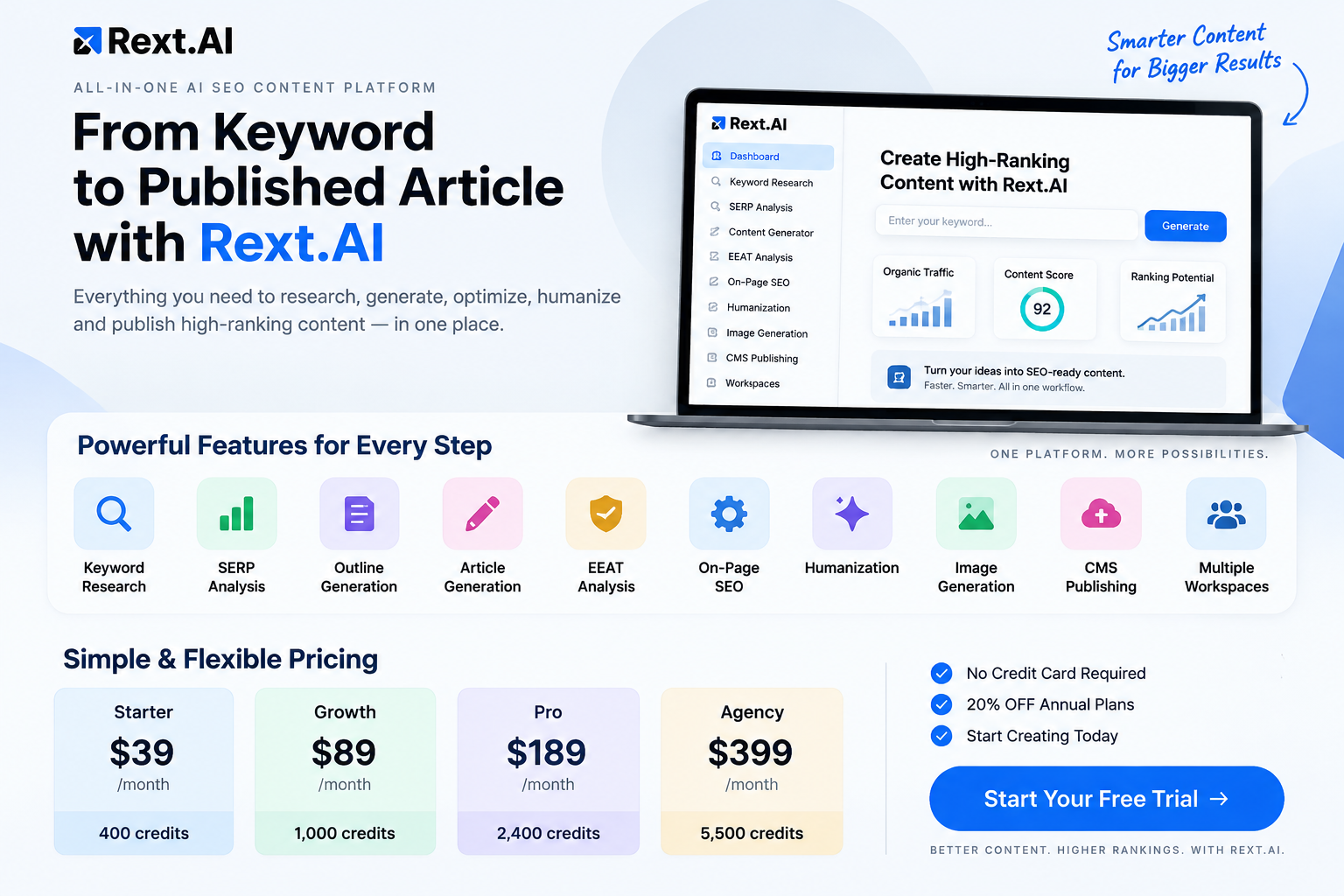
Rext AI takes a broader approach to the SEO content workflow. Instead of stopping at recommendations inside a content editor, it combines keyword research, SERP analysis, outline generation, article generation, EEAT analysis, on-page SEO, humanization, and optional CMS publishing within one workflow.
That makes it worth considering when your main problem is not simply optimizing an existing draft. It is more relevant when you want to reduce the number of separate steps needed to move from a keyword to a publishable article.
Key Features
Its current feature set includes:
- Unlimited keyword research across paid plans
- Analysis of the top 10 SERP results
- EEAT injection and analysis
- On-page SEO optimization
- Outline and article generation
- A humanization pass
- Optional AI image generation
- CMS publishing, including WordPress
- Multiple workspaces on higher plans
A useful distinction is the credit system. The company publishes the credit cost for individual actions instead of describing usage only through vague word limits. A standard SEO article is listed at 15 credits, while optional actions can use additional credits.
For teams producing content at scale, that makes monthly output easier to estimate.
Pricing Plans
Current monthly pricing starts at:
- Starter: $39 per month, 400 credits
- Growth: $89 per month, 1,000 credits
- Pro: $189 per month, 2,400 credits
- Agency: $399 per month, 5,500 credits
Annual billing currently reduces paid plan pricing by 20%. The platform also offers a free trial without requiring a card to start.
Best For
This approach makes the most sense for marketers, publishers, bloggers, and agencies that want research, generation, optimization, and publishing closer together.
It may be less relevant if you already have a mature writing stack and only want a dedicated optimization editor.
4. Clearscope, A Surfer SEO Competitor for Content Optimization
Clearscope is a well-established option for teams that care heavily about content quality, optimization, and structured editorial workflows.
Its current offering has also expanded beyond traditional SEO. Clearscope now describes its plans around both SEO and AI search visibility, with tracked prompts and pages included in its packages.
That makes the platform particularly interesting for established content teams that want to monitor content rather than optimize a draft once and forget about it.
Key Features
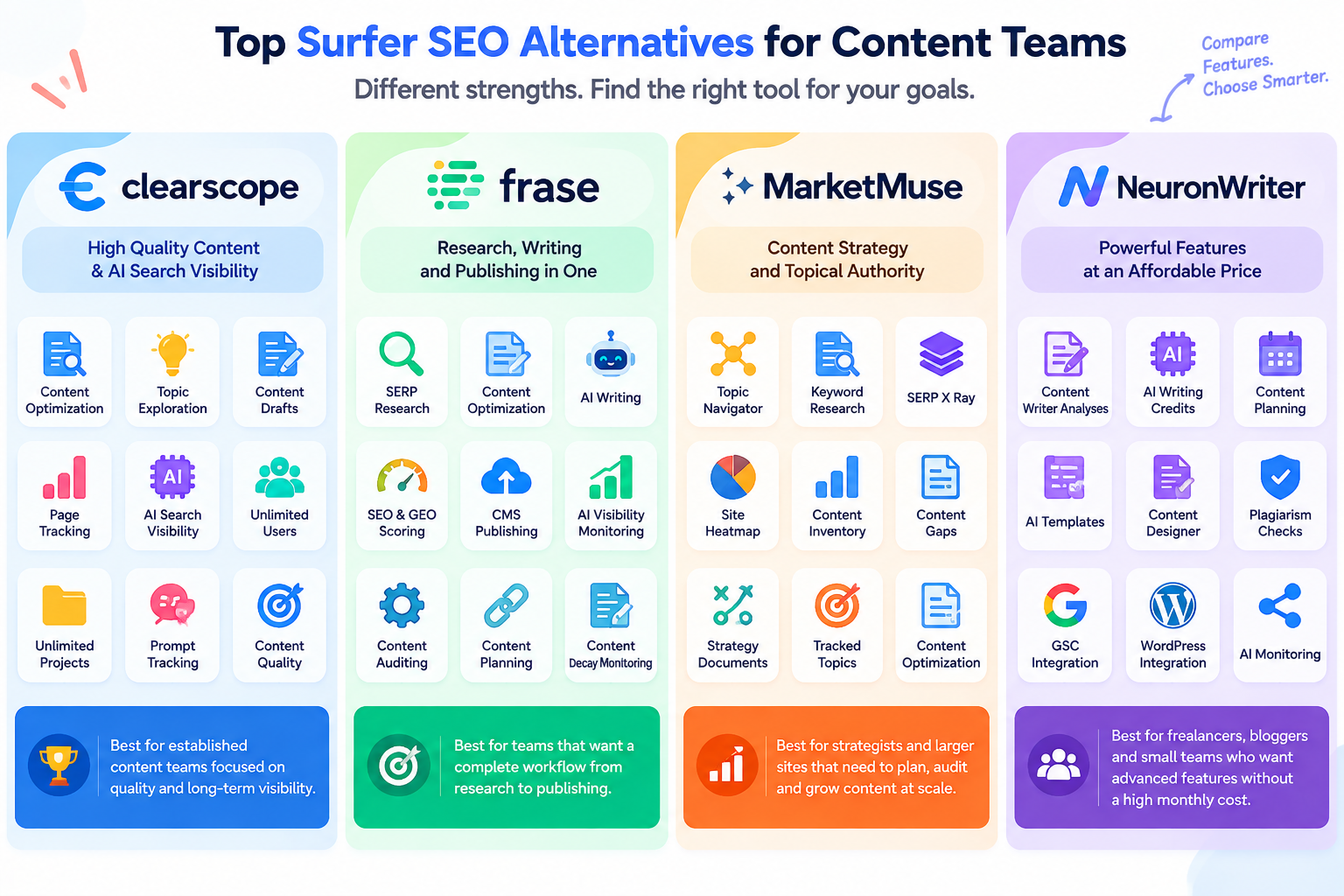
Clearscope focuses on areas such as:
- Content optimization
- Topic exploration
- Content drafts
- Page tracking
- AI search visibility
- Prompt tracking
- Unlimited users
- Unlimited projects
One benefit for larger editorial teams is its unlimited user model. You do not necessarily want pricing to jump every time another editor, strategist, or writer needs access.
Pricing Plans
Clearscope currently lists three primary plans:
- Essentials: $129 per month
- Business: $399 per month
- Enterprise: Custom pricing
Essentials currently includes 50 tracked prompts, 50 pages, 20 monthly Topic Explorations, and 20 monthly Drafts. Business increases the tracked prompts and pages to 300 each and adds a dedicated account manager. A 14-day free trial is available.
That places Clearscope toward the premium end of this comparison.
Best For
Clearscope is worth considering for editorial and content teams that place a high value on optimization quality and do not need the cheapest possible platform.
If budget is your biggest constraint, lower-priced alternatives may make more sense.
5. Frase, A Surfer SEO Alternative for SERP Research and AI Writing
Frase has evolved from an SEO research and optimization product into what it calls a content operating system for AI search.
Its current workflow combines content creation with SEO and GEO scoring, publishing, auditing, and AI visibility features. The Starter plan can publish directly to WordPress, Webflow, Sanity, Wix, or FraseCMS.
That combination makes Frase attractive when research and writing need to happen in the same environment.
Key Features
Depending on the plan, Frase can support:
- SEO and GEO scoring
- Content research
- Content optimization
- AI-assisted writing
- Content auditing
- AI visibility monitoring
- CMS publishing
- Content decay monitoring
The practical advantage is workflow continuity. Research does not have to live in one platform, the brief in another, and publishing somewhere else.
That can matter more than having the longest feature list.
Pricing Plans
Frase currently lists its Starter plan at $49 per month when billed monthly, or $39 per month with annual billing. It includes one seat, one site, 10 articles, and 50 audit pages per month. A seven-day trial is available without a credit card.
Higher plans increase capacity and are aimed at content teams with larger workflows.
Best For
Frase fits writers and teams that want SERP research, optimization, drafting, and publishing connected in one workflow.
It is also worth exploring if GEO scoring and AI visibility are becoming part of your content process.
6. MarketMuse, A Surfer SEO Alternative for Content Strategy
MarketMuse approaches SEO from a different angle.
While individual page optimization matters, MarketMuse places substantial emphasis on your broader content inventory, topical coverage, gaps, and content strategy.
This distinction becomes important when a site already has hundreds or thousands of pages.
At that point, asking "How should we optimize this article?" is only part of the problem.
You also need to ask:
- Which topic should we cover next?
- Where is our authority strongest?
- Which existing page deserves an update?
- What are we missing?
- Which content opportunity deserves resources?
MarketMuse is designed around those larger content decisions.
Key Features
Its current platform includes:
- Topic Navigator
- Keyword research
- SERP X ray
- SERP Heatmap
- Site Heatmap
- Content inventories
- Tracked topics
- Content briefs
- Strategy documents
- Content optimization
MarketMuse says it uses proprietary data and topic modeling rather than relying only on generic API data.
Pricing Plans
MarketMuse currently offers:
- Free: 10 queries per month
- Optimize: includes 100 tracked topics and five briefs monthly
- Research: includes 1,000 tracked topics and 10 briefs
- Strategy: includes 10,000 tracked topics and 20 briefs
Its public pricing page currently directs users to book a demo for paid tiers rather than displaying dollar prices in the retrieved plan summary.
The free level is notable because users searching for a Surfer SEO free alternative can explore parts of the platform before moving into a paid workflow.
Best For
MarketMuse is best suited to content strategists, established publishers, and larger teams that need to decide what to create and update across an entire content library.
If you only need a simple editor for one article at a time, it may be more platform than you need.
7. NeuronWriter, An Affordable Surfer SEO Alternative
NeuronWriter stands out mainly because it offers a wide range of SEO and AI features at comparatively accessible starting prices.
Its platform combines content optimization with AI writing, content planning, integrations, plagiarism checks on qualifying plans, and AI visibility monitoring.
That makes it one of the more interesting affordable Surfer SEO alternatives for small teams.
Key Features
Depending on your plan, features include:
- Content Writer analyses
- AI writing credits
- Content planning
- AI templates
- Content Designer
- Plagiarism checks
- Google Search Console integration
- WordPress integration
- Shopify integration
- API access on qualifying plans
- AI monitored questions
NeuronWriter also lists monitoring across Google, Google AI Overviews, AI Mode, ChatGPT, and Perplexity through its AI Monitoring offering.
Pricing Plans
Current monthly prices are:
- Bronze: $23
- Silver: $45
- Gold: $69
- Platinum: $93
- Diamond: $117
Annual billing reduces those monthly equivalent prices to $19, $37, $57, $77, and $97 respectively. A seven day trial under Gold plan terms is available.
The Gold plan is where several advanced capabilities become available, including integrations, advanced AI templates, plagiarism checking, and Content Designer.
Best For
NeuronWriter deserves consideration from freelancers, bloggers, small agencies, and site owners who want NLP SEO tools and content optimization without starting at a high monthly price.
When comparing Surfer SEO vs NeuronWriter, pay close attention to limits and workflow rather than price alone.
8. Semrush SEO Writing Assistant vs Surfer SEO
Semrush is the broadest SEO ecosystem in this comparison.
That makes Semrush vs Surfer SEO slightly different from comparing two dedicated content editors.
Surfer centers heavily on content optimization and related content workflows. Semrush covers a much wider SEO stack, including keyword research, competitor research, site auditing, position tracking, content tools, and more.
For content specifically, there are two offerings worth understanding.
The SEO Writing Assistant evaluates areas such as SEO, readability, tone, and originality. Semrush also offers a newer Content Toolkit for ideation, briefs, AI content creation, optimization, and publishing.
Key Features
The content ecosystem includes capabilities such as:
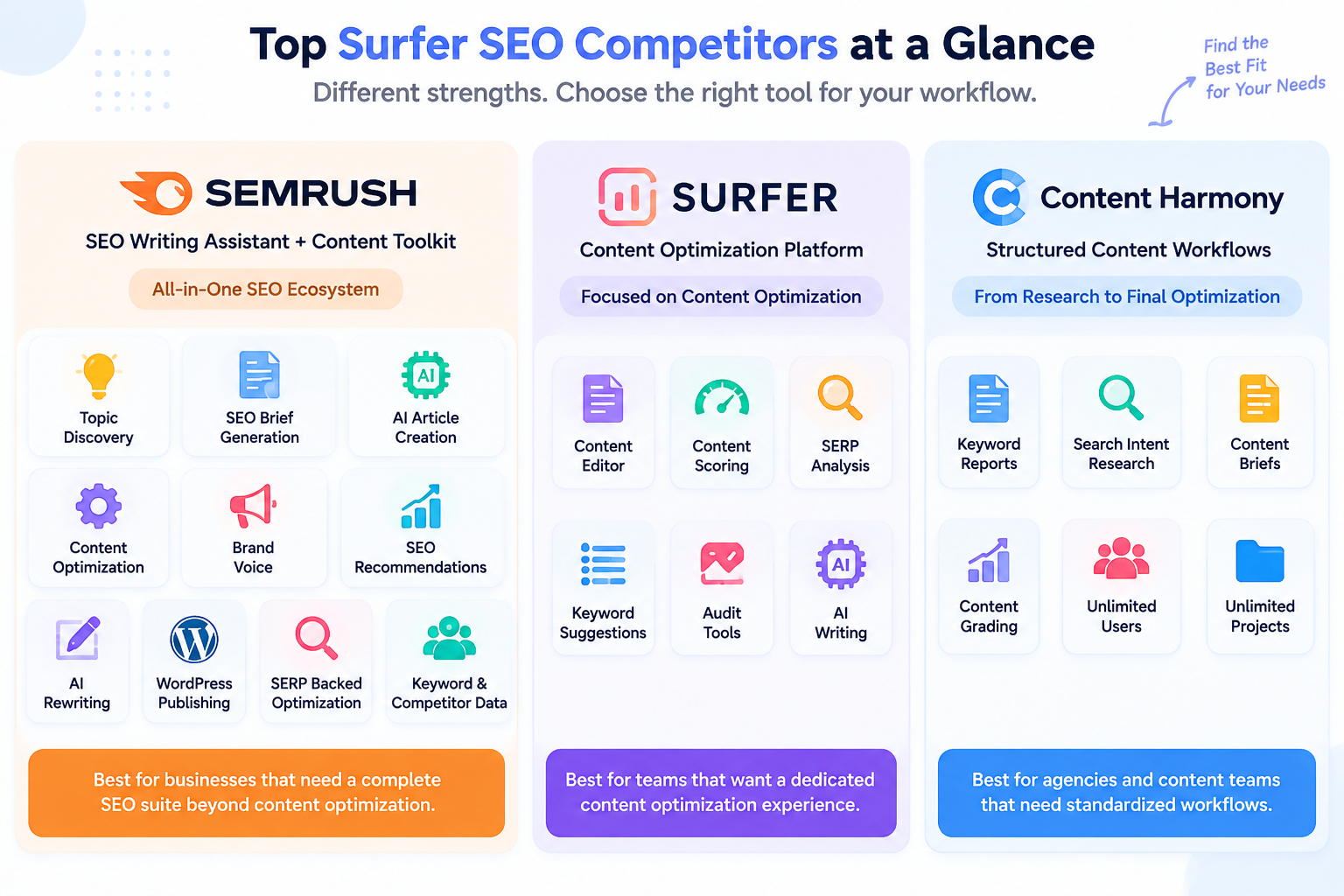
- Topic discovery
- SEO brief generation
- AI article creation
- Content optimization
- Brand voice
- SEO recommendations
- AI rewriting
- WordPress publishing
- SERP backed optimization
- Broader keyword and competitor data
The bigger advantage appears when your team already uses Semrush.
Adding content tools to an existing SEO workflow may be simpler than adopting another standalone platform.
Pricing Plans
The Semrush Content Toolkit currently costs $60 per month and offers a seven day free trial. It includes unlimited standard articles, five SEO boosted articles per month, SEO briefs, content ideas, optimization, AI rewriting, and WordPress export.
The separate SEO Toolkit currently starts at $139.95 per month for Pro, while Guru costs $249.95 and Business costs $499.95 monthly. SEO Writing Assistant is included at the Guru level according to Semrush's current plan documentation.
This distinction matters. Do not assume every Semrush content feature comes with its cheapest SEO subscription.
Best For
Semrush makes the most sense when content optimization is only one part of your SEO work.
If you also need keyword research, technical SEO, competitor analysis, and rank tracking, consolidating tools may be useful.
If you only want a focused content optimization experience, a dedicated platform may feel simpler.
9. Content Harmony and WriterZen as Surfer SEO Competitors
Not every Surfer SEO competitor tries to solve the same problem.
Content Harmony and WriterZen illustrate this well. One places greater emphasis on structured content workflows and briefs. The other has strong keyword research and clustering functionality.
Content Harmony
Content Harmony is built around repeatable content workflows.
Each Content Workflow includes a Keyword Report, Content Brief, and Content Grader. This creates a logical process from research to instructions to final optimization.
Key Features
- Keyword reports
- Search intent research
- Content briefs
- Content grading
- Unlimited users
- Unlimited projects
- Rollover credits
- Team training
For agencies, unlimited users and projects can be particularly useful. A cheap base plan becomes less attractive if every additional team member creates another fee.
Pricing Plans
Pricing scales by monthly Content Workflows:
- 5 workflows: $50 per month
- 12 workflows: $99
- 25 workflows: $199
- 50 workflows: $299
- 100 workflows: $599
- 150 workflows: $799
- Enterprise: from $1,000 per month
There is also a $10 trial that provides 10 workflow credits and does not automatically convert into a subscription.
Best For
Content Harmony is particularly relevant for agencies and content teams that need standardized briefs and a clear handoff between strategists, writers, and editors.
WriterZen
WriterZen takes a more keyword centered approach.
It is useful when your challenge begins before the writing stage. Instead of simply asking how to optimize one article, you can research keywords and group related opportunities before building the content.
Key Features
Its current plans advertise capabilities such as:
- Keyword research
- Keyword clustering
- Keyword lists
- Keyword Explorer
- Content Creator
- AI writing on qualifying plans
- Plagiarism checking
- Topic discovery
- Team collaboration
Pricing Plans
WriterZen currently promotes one time pricing rather than a standard monthly subscription.
Its Keyword Research package is listed at $135 one time, while All In One Basic costs $270 one time. The latter adds Content Creator functionality, up to 50 articles per month, unlimited AI writing, and plagiarism checking. That pricing structure is unusual in a category dominated by subscriptions.
Best For
WriterZen is worth considering when keyword discovery and keyword clustering are major parts of your workflow.
It may be particularly attractive to people who dislike adding another recurring software subscription.
10. Surfer SEO Alternatives Comparison: Features, Pricing and Best Use Cases
There is no single feature that determines the right platform.
Use this comparison as a starting point, then test your shortlist with the type of content you actually produce.
Tool | Best For | SERP/SEO Analysis | AI Writing | Broader Planning | Starting Price |
Rext AI | End to end Complete SEO workflow | Yes | Yes | Strong | $32/mo |
Clearscope | Editorial optimization | Yes | Draft workflow | Yes | $129/mo |
Frase | Research, writing and GEO workflow | Yes | Yes | Yes | $49/mo monthly |
MarketMuse | Content strategy and topical planning | Yes | Optimization focused | Strong | Free tier |
NeuronWriter | Affordable optimization | Yes | Yes | Yes | $23/mo |
Semrush Content Toolkit | Wider SEO and content workflow | Yes | Yes | Strong | $60/mo |
Content Harmony | Briefs and agency workflows | Yes | No core focus | Strong | $50/mo |
WriterZen | Keyword research and clustering | Yes | Yes on qualifying plan | Strong | $135 one time |
Pricing and features change, sometimes quickly. The figures above reflect publicly available pricing checked in September 2026.
A better way to choose is to identify your bottleneck.
If writing takes too long: prioritize an AI SEO tool that connects research, outlining, generation, and optimization.
If writers miss search intent: prioritize SERP research and strong content briefs.
If your editors spend hours fixing drafts: prioritize clear grading and optimization guidance.
If you do not know what to publish: prioritize keyword research, topic discovery, clustering, and content gap analysis.
If you manage many clients: consider workspaces, users, API integrations, reporting, and publishing workflow.
If you already have hundreds of articles: content inventory, auditing, performance analysis, and planning become more valuable than another writing interface.
This is also where buying based on a feature checklist can go wrong.
Imagine an agency publishes 80 articles per month. A $30 tool may sound cheaper, but not if the team spends another 20 minutes moving every article between research, writing, optimization, and WordPress.
Those 20 minutes become more than 26 hours across 80 articles.
Workflow cost matters alongside subscription cost.
11. Which Surfer SEO Alternative Should You Choose?
Start with what you want to improve.
For an end to end AI content workflow, look for software that can move from keyword and SERP research into drafting, optimization, and publishing without unnecessary handoffs.
For editorial optimization, Clearscope is worth evaluating. Its focus on tracked content, topic exploration, and optimization suits teams that care about maintaining quality over time.
For SERP research combined with writing and GEO workflows, Frase is a strong candidate. Its current platform connects article creation, auditing, SEO and GEO scoring, AI visibility, and CMS publishing.
For content strategy and topical authority, MarketMuse deserves a closer look. Its site inventory, tracked topics, briefs, and strategy documents address decisions beyond a single article.
For lower cost content optimization, NeuronWriter starts at $23 monthly and gives users several tiers before reaching enterprise style pricing.
For broader SEO work, Semrush may make more sense if you also need competitor analysis, keyword research, technical auditing, and rank tracking.
For structured agency briefs, Content Harmony has a clear research, brief, and grading workflow.
For keyword clustering and research, WriterZen offers a different value proposition, especially because its current pricing uses one time payments.
The top Surfer SEO alternative therefore depends on the job you need done.
Do not ask only, "Which tool has the most features?"
Ask:
- Where does our content process slow down?
- Which steps require separate software?
- How many articles do we create each month?
- Do we need writing or only optimization?
- Do we need keyword research?
- Will several writers or clients use the account?
- Do we need Google Search Console, WordPress, or Shopify integrations?
- Are we measuring traditional rankings, AI visibility, or both?
- What will the platform actually cost at our volume?
The answer becomes much clearer after those questions.
For teams that want to combine research, SERP analysis, AI generation, EEAT analysis, on page optimization, humanization, and publishing, Rext AI is worth testing alongside the dedicated optimization tools above. Its current pricing starts at $32 per month, so you can compare the actual workflow and output rather than choosing from feature lists alone.
The key takeaway is simple: choose a platform around your workflow, not somebody else's "best tools" ranking. Surfer remains capable, but Clearscope, Frase, MarketMuse, NeuronWriter, Semrush, Content Harmony, WriterZen, and newer AI first platforms solve different parts of the content process.
Test two or three options with the same keyword and article. Compare research quality, editing time, optimization guidance, final output, and publishing effort. That small test will tell you far more than a feature checklist.
If you want research, writing, optimization, and publishing in a more connected workflow, start with a free trial and judge the platform using a real article you already plan to publish.
12. Frequently Asked Questions
What is the best alternative to Surfer SEO?
There is no universal best option. Clearscope suits editorial optimization, Frase combines research and AI content workflows, MarketMuse focuses on strategy, NeuronWriter offers lower cost optimization, and Semrush connects content with a broader SEO toolkit.
Choose based on the problem you need to solve rather than the number of features.
Is there a free alternative to Surfer SEO?
Yes, some tools offer free access or trials rather than permanently free full replacements. MarketMuse currently provides a Free plan with 10 queries per month. Frase offers a seven day trial, NeuronWriter offers a seven day Gold trial, and several other platforms provide trial access.
Always check current limits before choosing a free Surfer SEO alternative because free plans can change.
What should I look for when choosing a Surfer SEO competitor?
Look for accurate SERP analysis, useful content scoring, keyword research, search intent guidance, content briefs, AI writing where needed, integrations, transparent limits, and pricing that works at your publishing volume.
For larger teams, also consider collaboration, API access, client reporting, workspaces, and CMS publishing.
Is Semrush better than Surfer SEO for content optimization?
They serve overlapping but different needs. Surfer specializes heavily in content optimization and related workflows. Semrush covers a much wider SEO ecosystem, including keyword research, competitor research, auditing, rank tracking, and content tools.
Semrush may make more sense when you want broader SEO capabilities. A focused content platform may be simpler if optimization is your main need.
About the Author
Sania Usman
Sania is a technical writer at Rext AI with five years of experience in writing for SaaS products and technical writing. She joined Rext AI to make technical content clear without oversimplifying it. Sania specializes in topic clusters, on-page optimization, SAAS articles, and content that answers the questions people are actually searching for.