How to Choose the Best AI Content Generators for Marketing Teams in 2026:
Looking for the best AI content generator for marketing teams? Learn which AI content generators deliver better workflows, SEO optimization, and scalable growth for marketing teams in 2026.
Marketing teams face more pressure than ever to create high-quality content consistently. A few years ago, businesses could compete with a handful of blog posts, occasional social media updates, and basic email campaigns. Today, successful brands need a continuous stream of content across multiple channels, including search engines, social platforms, newsletters, websites, and customer education resources.
Marketing teams are now responsible for producing:
SEO blog articles
Landing pages
Product descriptions
Social media campaigns
Email newsletters
Advertising copy
Case studies
Customer guides
Sales enablement content
The challenge is that creating effective content requires much more than writing. A successful content marketing process involves understanding customer intent, researching topics, analyzing competitors, selecting keywords, creating outlines, maintaining brand consistency, optimizing for search engines, and measuring performance. This is where an AI content generator for marketing teams becomes valuable.
Modern AI content creation platforms help businesses streamline the entire content workflow by combining artificial intelligence, generative AI, SEO optimization, and automation. Instead of replacing marketers, AI marketing tools help teams work faster by reducing repetitive tasks and allowing professionals to focus on strategy, creativity, and customer insights.
Platforms such as Rext AI, Jasper, Copy.ai, Writesonic, ChatGPT, HubSpot AI, Semrush AI tools, Surfer AI, and Frase are helping businesses build more efficient content operations.
The future of marketing is not about choosing between humans and AI, instead about combining human expertise with AI-powered content creation to produce better, more relevant, and more scalable marketing campaigns.
Why Marketing Teams Need AI Content Generation Tools
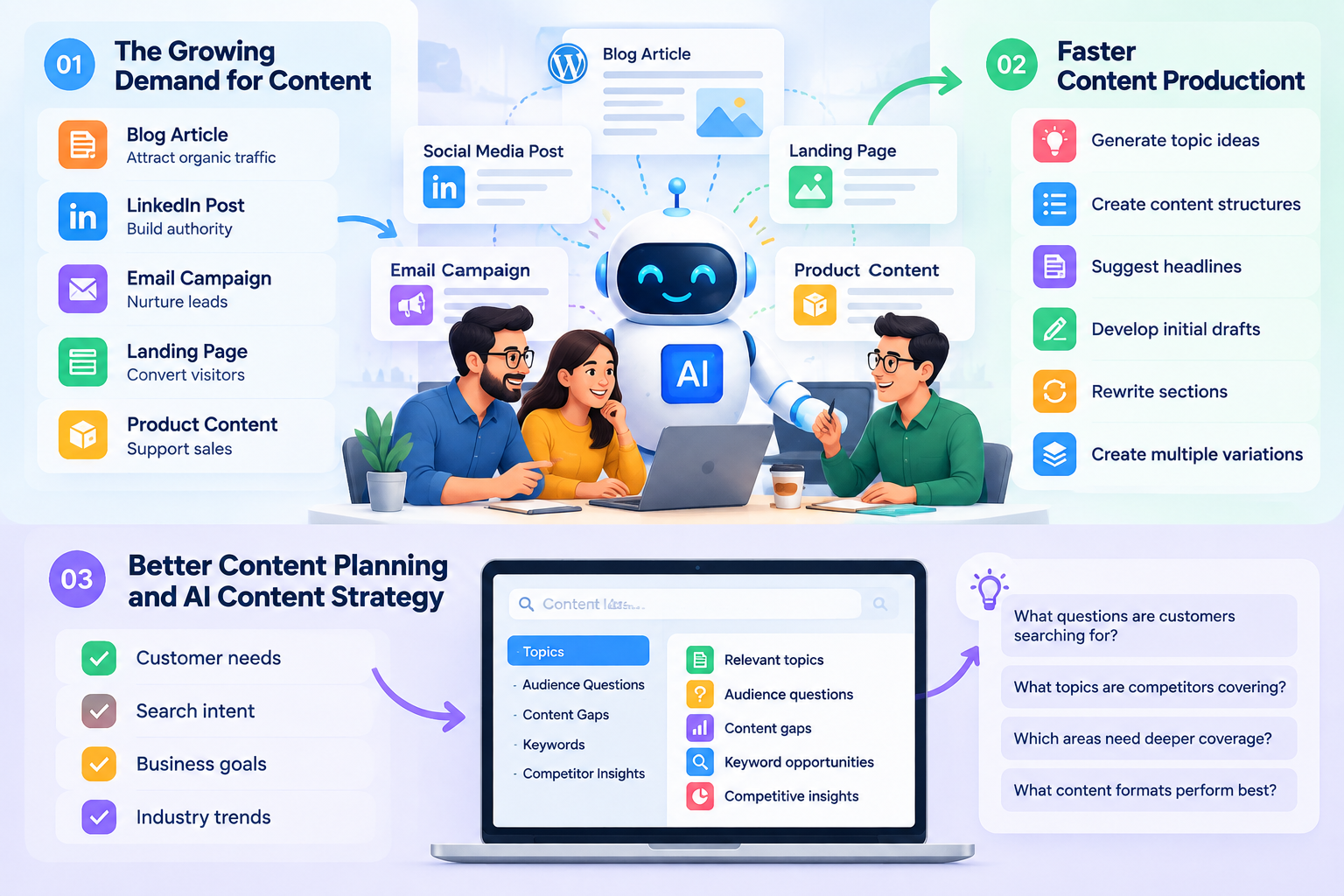
1. The Growing Demand for Content
Modern customers interact with brands across multiple platforms.
A company may need:
A blog article to attract organic traffic
A LinkedIn post to build authority
An email campaign to nurture leads
A landing page to convert visitors
Product content to support sales
Producing all of this manually requires significant time and resources. For many marketing teams, the biggest challenge is not having ideas, but it is turning ideas into high-quality content consistently. AI content generation tools help teams increase output without sacrificing strategic thinking.
2. Faster Content Production
Traditional content creation often involves multiple stages, starting from topic research to publishing, and includes many other steps that take many hours. This process can take days or weeks, but AI marketing tools reduce the time required for repetitive steps.
For example, marketers can use AI to:
Generate topic ideas
Create content structures
Suggest headlines
Develop initial drafts
Rewrite sections
Create multiple content variations
This allows teams to focus more on improving quality rather than starting from zero.
3. Better Content Planning and AI Content Strategy
Successful marketing depends on having a clear content strategy. Publishing random articles is no longer enough. Businesses need content that matches:
Customer needs
Search intent
Business goals
Industry trends
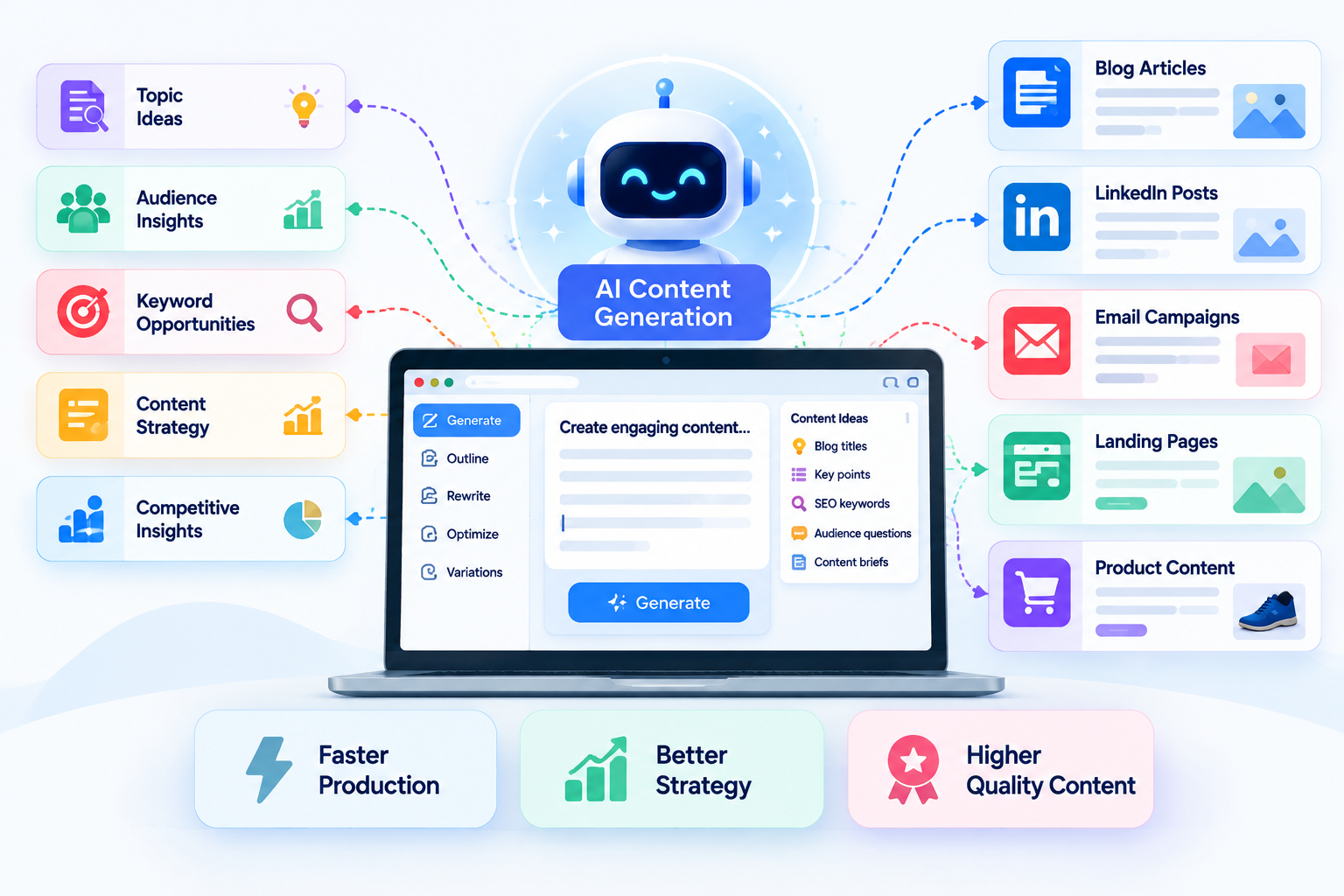
An AI content generator can support strategic planning by helping marketers discover:
Relevant topics
Audience questions
Content gaps
Keyword opportunities
Competitive insights
For example, before creating an article, an AI marketing platform can help answer:
What questions are customers searching for?
What topics are competitors covering?
Which areas need deeper coverage?
What content formats perform best?
This helps teams create content based on strategy rather than assumptions.
How AI Content Creation Is Changing Marketing Workflows
AI is not only changing how marketers write, but it is changing the entire content workflow.
Now, a modern AI-powered content marketing process often includes:
Research → Strategy → Creation → Optimization → Distribution → Analysis
Each stage can be improved with AI assistance.
AI-Assisted Content Research
Before creating content, marketers need accurate research, and AI-assisted tools can support:
Topic Discovery
AI can help identify:
Trending topics
Related questions
Audience concerns
Content opportunities
Competitor Analysis
Marketing teams can analyze:
Competitor content structures
Common themes
Missing information
Opportunities for differentiation
Audience Understanding
AI helps marketers understand:
Customer problems
Search behavior
Buying questions
Content preferences
This research creates stronger foundations for content creation.
AI and SEO Content Optimization
Creating content is only useful if people can discover it, that is why SEO content optimization has become an important part of AI marketing workflows.
Modern AI content tools can support:
Keyword research
Search intent analysis
Content structure recommendations
Topic coverage
Semantic optimization
SEO-focused platforms such as Surfer AI, Semrush, and Frase combine AI capabilities with search data to help marketers create more competitive content. Platforms like Rext AI also focus on helping teams combine content generation with optimization workflows.
AI Content Creation for Different Marketing Channels
Modern marketing teams rarely create content for only one channel. A successful content strategy requires businesses to communicate with audiences across multiple platforms while maintaining consistent messaging. An AI content generator helps marketers adapt content for different channels while reducing repetitive work.
AI Content Generation for Blog Content
SEO blogs remain one of the most important channels for attracting organic traffic. However, creating high-quality blog content requires:
Keyword research
Search intent analysis
Competitor research
Content outlining
Writing
Optimization
Updating old articles
An AI-powered content creation platform can support marketers throughout this process.
For example, an AI marketing platform can help a team transform a simple topic idea into a detailed content plan before writing begins.
However, the strongest results come when AI-generated drafts are improved with human expertise, industry experience, and original insights.
AI Marketing Content Generator for Social Media
Social media requires frequent content creation, and marketing teams need fresh ideas for:
LinkedIn posts
Instagram captions
X/Twitter updates
Facebook campaigns
Community posts
AI Content Generation for Email Marketing
Email marketing remains one of the most effective channels for customer communication. However, writing effective emails requires understanding:
Customer intent
Personalization
Timing
Brand voice
Conversion psychology
AI content generation tools can help marketers create:
Newsletter drafts
Promotional emails
Welcome sequences
Follow-up messages
Subject line variations
Marketing teams can use AI to test different messaging approaches while maintaining consistency.
AI for Website and Conversion Content
Website content directly impacts customer decisions, so businesses need persuasive copy for:
Homepage sections, landing and service pages, product descriptions and case studies.
An AI marketing content generator can help teams create:
Benefit-focused messaging
Different copy variations
Customer-focused descriptions
Conversion-driven headlines
The final content should always reflect the brand’s expertise and customer understanding.
AI provides speed, but human marketers provide strategy.
What Key Features to Look for in an AI-Powered Content Creation Platform
Not every AI writing tool provides the same value. Marketing teams should look beyond simple text generation and evaluate whether a platform supports the complete content workflow.
Important features include:
1. AI Writing Assistant Capabilities
A strong AI writing assistant should help marketers with:
Draft creation
Sentence improvement
Tone adjustments
Content expansion
Content rewriting
Editing suggestions
This allows marketers to improve existing content instead of always starting from scratch.
2. Brand Voice Management
Maintaining brand consistency is one of the biggest challenges for growing marketing teams because different writers, freelancers, and departments may create content differently.
AI marketing platforms with brand voice capabilities help businesses maintain:
Consistent tone
Preferred terminology
Messaging guidelines
Communication style
This is especially valuable for:
SaaS companies
Agencies
Enterprise businesses
Multi-channel marketing teams
3. SEO Content Optimization
A modern AI content creation platform should understand that content success depends on visibility.
SEO optimization features can help marketers improve:
Keyword usage
Topic coverage
Content depth
Search intent alignment
Semantic relevance
AI combined with SEO strategy helps businesses create content that serves both users and search engines.
4. Content Workflow Automation
Creating content involves many steps beyond writing.
Instead of managing multiple disconnected tools, teams can create a more organized production process.
5. Marketing Automation Integration
Modern marketing depends on connected systems.
AI marketing platforms can work alongside:
CRM platforms
Analytics tools
SEO software
Publishing systems
Marketing automation platforms
This creates a smoother workflow from content creation to campaign measurement.
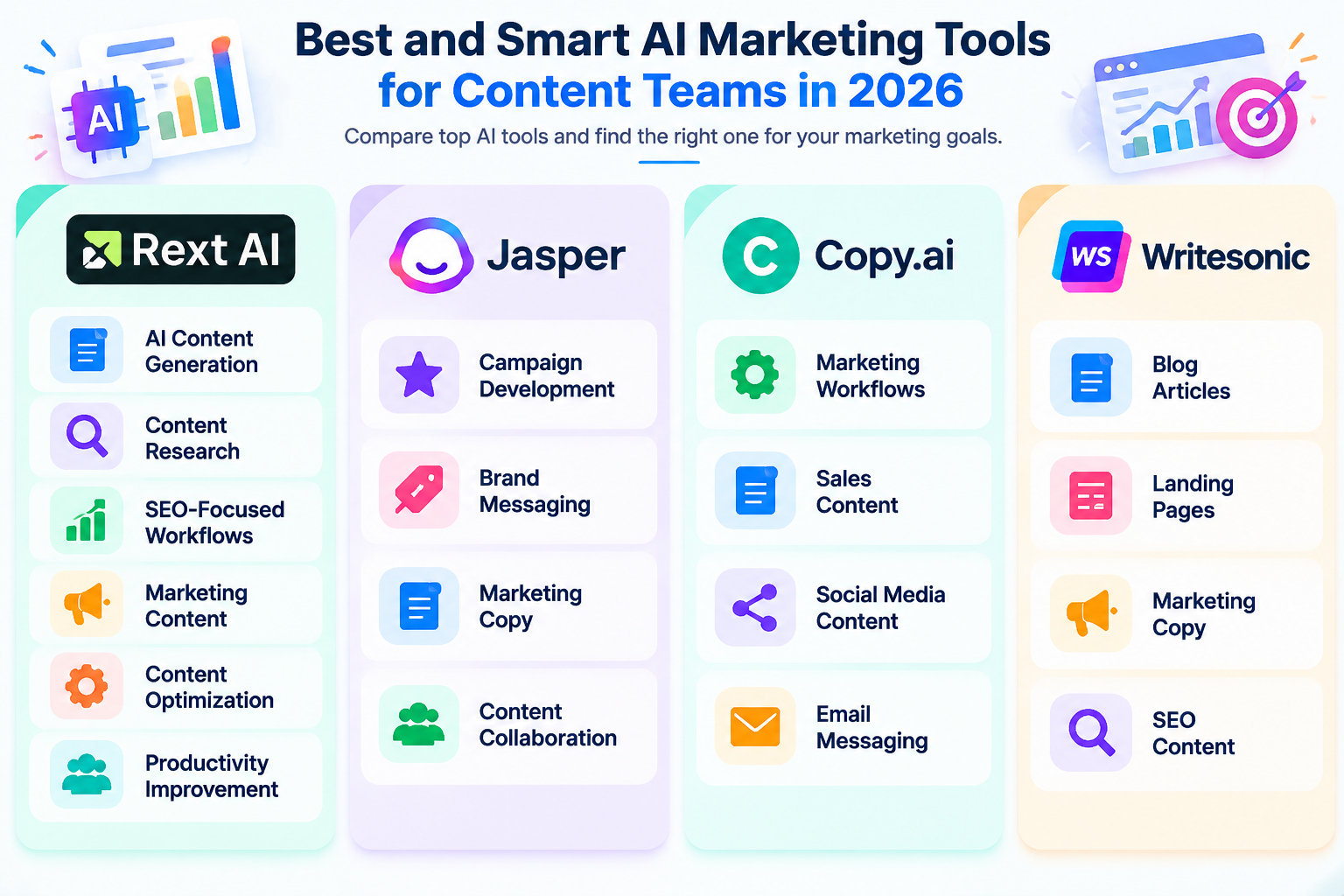
Best and Smart AI Marketing Tools for Content Teams in 2026
The AI marketing ecosystem has expanded significantly, so different platforms solve different problems; businesses should select tools based on their goals.
1. Rext AI: AI-Powered Content Creation Platform for Marketing Teams
Rext AIis designed to help marketing teams streamline content creation through AI-powered workflows.
Rather than focusing only on generating text, Rext AI supports a broader content process, helping teams move from research and planning to content creation and optimization.
Key areas where Rext AI supports marketers include:
AI content generation
Content research assistance
SEO-focused content workflows
Marketing content creation
Content optimization
Productivity improvement
For teams looking for a structured AI content workflow instead of a basic writing assistant, platforms like Rext AI can provide a more complete approach.
2. Jasper: AI Marketing Platform for Enterprise Teams
Jasper is one of the well-known AI marketing platforms focused on business content creation specifically for marketing. It is popular with teams that produce campaign messaging, marketing copy, and collaborative content at volume.
Where it fits: Organizations where many people create content and the brand voice has to stay recognizable across all of it.
Worth considering: Jasper is aimed at business use, so smaller teams or solo marketers should weigh the cost against how much they will use the more advanced collaboration and brand features.
Marketing Team uses Jasper for:
Campaign development
Brand messaging
Marketing copy
Content collaboration
Jasper is particularly useful for organizations that need strong brand consistency across large teams.
3. Copy.ai: AI Marketing Workflows and Content Automation
Copy.ai focuses on AI-powered marketing workflows. Copy.ai started as a copywriting tool and has moved toward automating marketing and sales workflows. Teams use it for campaign content, social copy, email messaging, and sales content.
Where it fits: Teams that want to automate repeatable tasks, especially where marketing and sales content overlap.
Worth considering: If your main need is long-form SEO articles with detailed search data, you may want to pair it with a dedicated SEO tool.
Common use cases include:
Sales content
Marketing campaigns
Social media content
Email messaging
Copy.ai is often used by teams looking to automate repetitive marketing tasks.
4. Writesonic: AI Content Generation and SEO Writing
Writesonic provides AI writing tools designed for marketers, bloggers, and businesses. Writesonic offers AI writing tools aimed at marketers, bloggers, and small businesses. It covers blog articles, landing pages, marketing copy, and SEO content, and it has added features focused on how brands appear in AI-driven search.
Where it fits: Teams and small businesses that want fast, affordable-feeling production of SEO-oriented content.
Worth considering: Drafts produced quickly still need careful editing for accuracy, depth, and a distinct voice.
It helps users create:
Blog articles
Landing pages
Marketing copy
SEO content
Writesonic is commonly considered by teams looking for faster AI-assisted content production.
5. ChatGPT: Flexible Generative AI Assistant
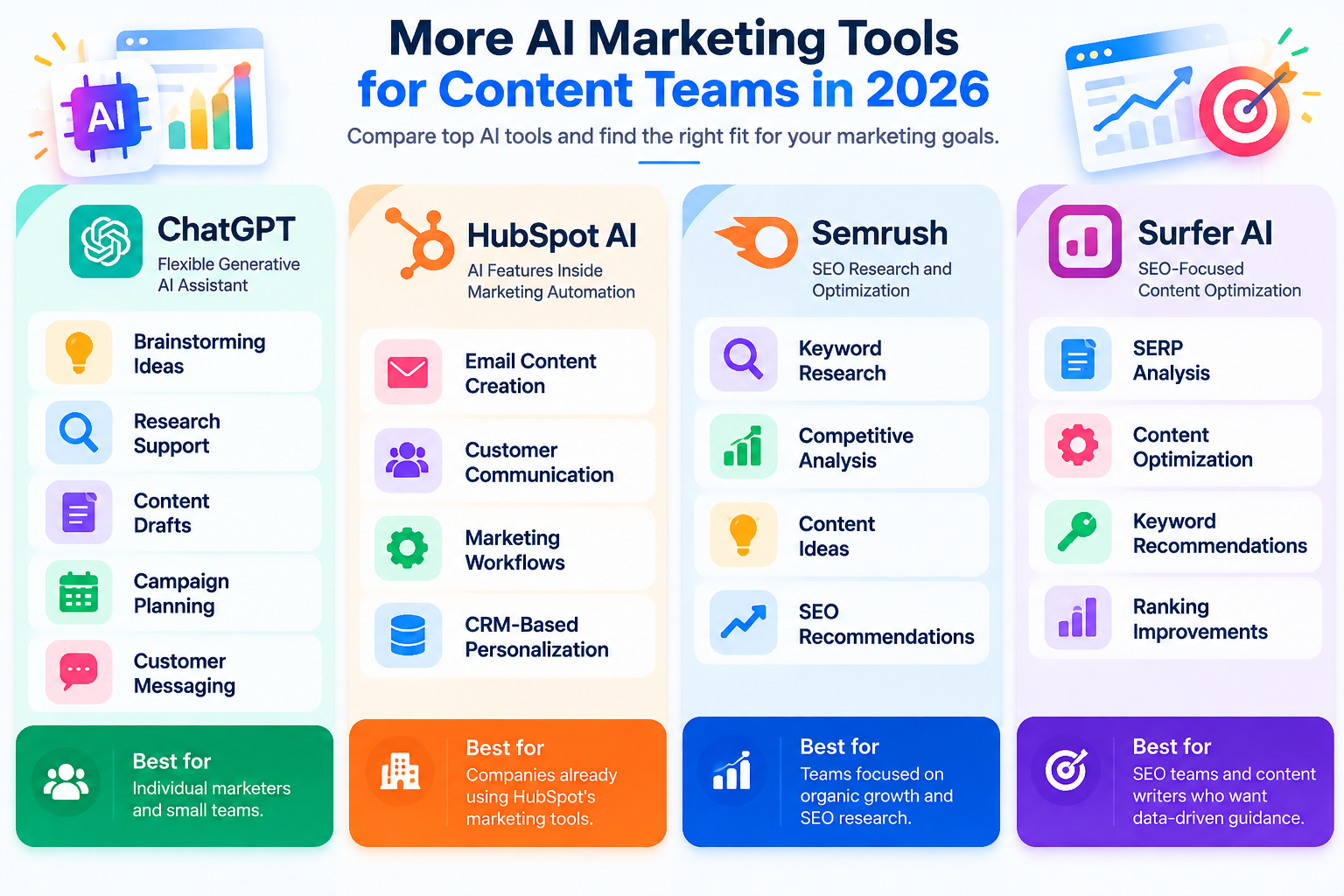
ChatGPT is one of the most widely used generative AI tools, and marketers rely on it for brainstorming, research support, content drafts, campaign planning and customer messaging. Its flexibility is its biggest strength.
Where it fits: Individual marketers and small teams who want a versatile assistant for many kinds of tasks.
Worth considering: It does not come with built-in SEO scoring, approval workflows or team brand controls. Many companies pair it with a specialized platform for those needs.
Marketing teams use ChatGPT for:
Brainstorming ideas
Research support
Content drafts
Campaign planning
Customer messaging
Its flexibility makes it useful across many marketing tasks.
However, companies often combine ChatGPT with specialized AI marketing tools when they need:
SEO workflows
Team collaboration
Brand controls
Marketing automation
6. HubSpot AI: AI Features Inside Marketing Automation
HubSpot integrates AI capabilities into its broader marketing ecosystem.HubSpot builds AI features into its marketing, sales and CRM tools. These cover email content, customer communication, workflow support and personalization based on CRM data.
Where it fits: Companies that already run their marketing on HubSpot and want AI assistance without adding another tool.
Worth considering: Its biggest advantage is the connection to your existing HubSpot data, so the value drops if your team does not use the wider HubSpot ecosystem.
It supports:
Email content creation
Customer communication
Marketing workflows
CRM-based personalization
HubSpot AI is particularly useful for companies already using HubSpot’s marketing tools.
7. Semrush AI Tools: SEO Research and Optimization
Semrush is widely recognized for SEO and digital marketing research. Semrush is widely used for SEO and digital marketing research because it’s AI-supported features help with keyword research, competitive analysis, content ideas and optimization recommendations.
Where it fits: Teams focused on organic growth that want their content decisions backed by search and competitor data.
Worth considering: Semrush covers a lot of ground, so there is a learning curve, and it works best for teams that will use the research features and not just the writing tools.
Its AI-powered features help marketers with:
Keyword research
Competitive analysis
Content ideas
SEO recommendations
For teams focused heavily on organic growth, SEO data combined with AI can improve content decisions.
8. Surfer AI: SEO-Focused Content Optimization
Surfer helps marketers create content that matches what already performs in search results because it offers SERP analysis, keyword recommendations, and content optimization guidance, along with AI drafting.
Where it fits: SEO teams and content writers who want clear, data-backed guidance on structure and topic coverage.
Worth considering: Optimization scores are a guide, not a guarantee. Content still needs real insight to stand out.
It provides support for:
SERP analysis
Content optimization
Keyword recommendations
Ranking improvements
Surfer is often used by SEO teams that want data-driven content creation.
9. Frase: AI Content Research and Optimization
Frase combines AI writing with content research and analyzes search results, helps build content briefs, supports article optimization, and improves topic coverage.
Where it fits: Content teams that want to spend less time on research and brief creation before writing starts.
Worth considering: It is strongest in the research and optimization stages, so teams wanting heavy workflow management may need additional tools.
It helps marketers:
Analyze search results
Build content briefs
Optimize articles
Improve topic coverage
AI Content Generator Comparison Table
Platform
Best For
Main Strength
Rext AI
Marketing teams
AI content workflow and optimization
Jasper
Enterprise marketing
Brand consistency
Copy.ai
Marketing automation
Workflow-based content creation
Writesonic
SEO content
AI article generation
ChatGPT
General AI assistance
Flexible content support
HubSpot AI
CRM-based marketing
Marketing automation
Semrush AI
SEO teams
Research and optimization
Surfer AI
Search-focused content
SEO improvements
Frase
Content research
Optimization workflows
How Marketing Teams Can Build an Effective AI Content Strategy
Using an AI content generator successfully requires more than simply generating articles or social media posts.
The most successful marketing teams treat AI as part of a broader AI content strategy that combines technology, human expertise, and business goals.
A strong AI-powered content workflow follows a structured process:
Strategy → Research → Creation → Optimization → Distribution → Measurement
Each stage helps marketing teams produce content that is more relevant, efficient, and valuable.
Step 1: Define Your Content Marketing Goals
Before selecting AI marketing tools, businesses should clearly define what they want to achieve.
Different goals require different content approaches.
Common objectives include:
Increasing Organic Traffic
Generating Leads
Building Brand Awareness
Improving Customer Education
AI tools become more effective when connected with specific marketing goals.
Step 2: Identify Your Content Requirements
Every marketing team has different content needs.
A SaaS company may require:
Technical blogs
Product documentation
Comparison pages
An ecommerce brand may need:
Product descriptions
Buying guides
Promotional content
An agency may need:
Client resources
Social media campaigns
Case studies
Understanding content requirements helps teams choose the right AI content generation tools.
Step 3: Select the Right AI Marketing Tools
The best AI marketing platform depends on business needs.
For example:
For General AI Assistance
Tools like ChatGPT are useful for:
Brainstorming
Research
Content ideas
For Enterprise Marketing Teams
Platforms like Jasper focus on:
Brand consistency
Team collaboration
Marketing workflows
For SEO Content
Tools like Surfer AI, Semrush, and Frase help with:
Search optimization
Content analysis
Keyword strategy
For Complete AI Content Workflows
Platforms such as Rext AI help teams combine:
Content creation
Optimization
Workflow efficiency
Step 4: Create Repeatable Content Workflows
Successful marketing teams do not use AI randomly.
They create repeatable systems.
A typical AI-powered content workflow may look like:
Content Planning
↓
Identify topic opportunities
↓
AI-Assisted Research
↓
Analyze audience needs and search intent
↓
Content Creation
↓
Generate drafts and variations
↓
Human Review
↓
Add expertise, examples, and brand insights
↓
SEO Optimization
↓
Improve structure and search visibility
↓
Publishing and Promotion
↓
Distribute across marketing channels
Step 5: Combine AI With Human Expertise
AI can generate content quickly, but human input remains essential.
The strongest content combines:
AI Advantages
Speed
Scale
Idea generation
Pattern recognition
Automation
Human Advantages
Experience
Creativity
Strategic thinking
Industry knowledge
Emotional understanding
For example, an AI tool can help draft a healthcare article, but a healthcare marketing expert can add:
Real-world examples
Industry experience
Customer challenges
Practical recommendations
This combination creates content that is more trustworthy and valuable.
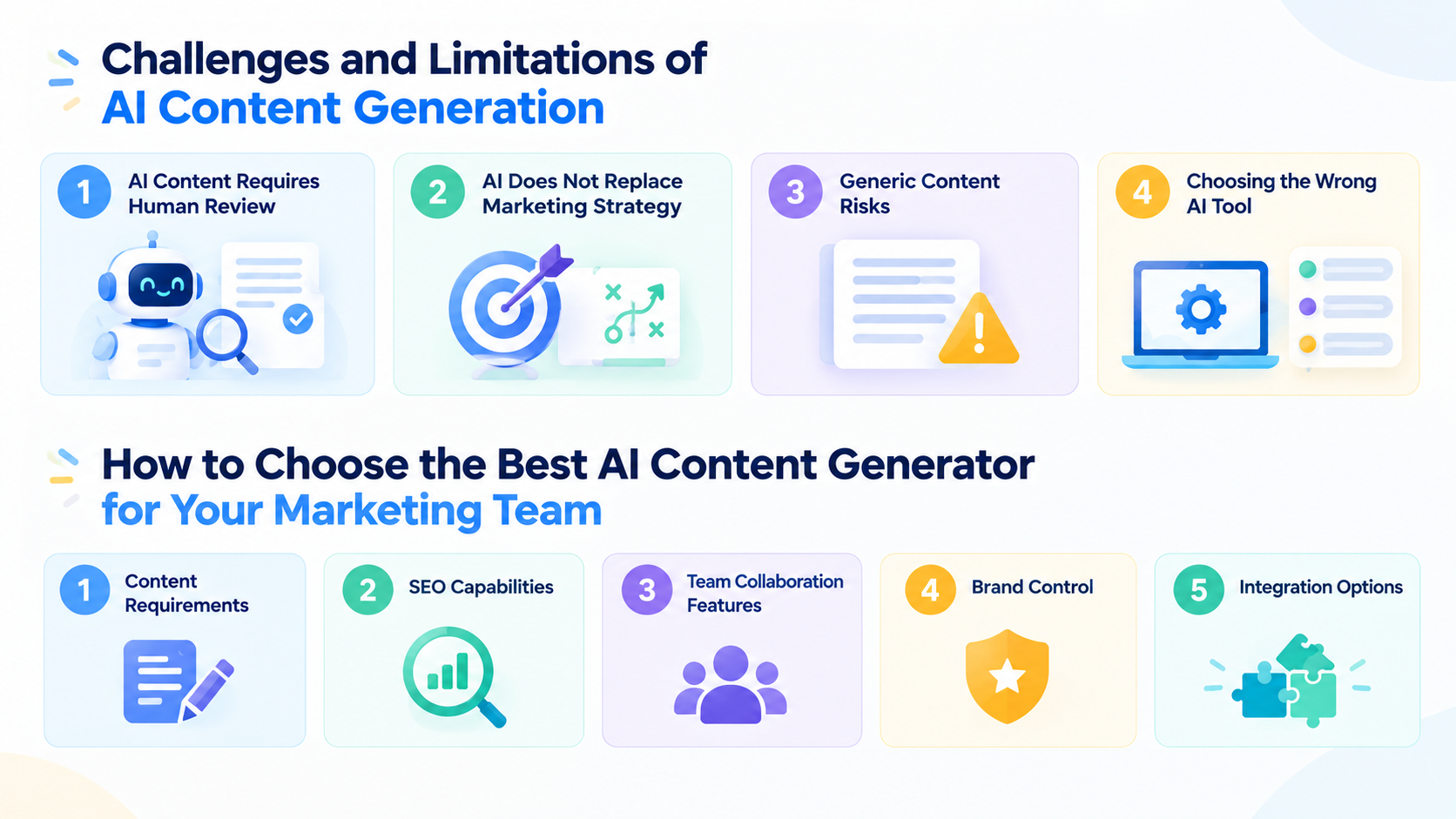
Challenges and Limitations of AI Content Generation
Although AI content generation tools provide significant benefits, marketers should understand their limitations.
1. AI Content Requires Human Review
AI-generated content can sometimes include:
Incorrect information
Generic statements
Missing context
Human editors should review content for:
Accuracy
Brand alignment
Expertise
Originality
2. AI Does Not Replace Marketing Strategy
A tool can generate text, but it does not fully understand:
Business objectives
Customer psychology
Brand positioning
Successful marketing still requires human decision-making.
3. Generic Content Risks
If businesses rely only on AI output, content may become:
Too general
Similar to competitors
Less engaging
The solution is adding:
Original examples
Expert opinions
Data
Personal experience
4. Choosing the Wrong AI Tool
Not every AI content generation tool is suitable for every business.
Companies should evaluate:
Features
Integrations
Security
Collaboration options
SEO capabilities
Workflow support
AI Content Generator vs Traditional Content Creation
Traditional Content Creation
AI-Assisted Content Creation
Research takes longer
Faster research assistance
Writers start from blank pages
AI provides initial drafts
Manual content variations
Multiple versions quickly
Separate optimization process
Integrated SEO support
Harder to scale
Easier content expansion
The goal is not replacing traditional marketing.
The goal is creating a smarter and more efficient workflow.
How to Choose the Best AI Content Generator for Your Marketing Team
Before investing in an AI marketing platform, consider these factors:
1. Content Requirements
Ask:
What type of content do we create?
How frequently do we publish?
Which channels do we use?
2. SEO Capabilities
For organic growth, look for:
Keyword support
Search intent analysis
Optimization features
Content recommendations
3. Team Collaboration Features
Growing teams need:
Multiple users
Workflow management
Approval processes
Content organization
4. Brand Control
A good AI platform should help maintain:
Brand voice
Messaging consistency
Style preferences
5. Integration Options
Consider whether the platform connects with:
CMS platforms
Analytics tools
CRM systems
Marketing automation software
The Future of AI Content Creation for Marketing Teams
AI content creation is moving beyond simple text generation.
The next generation of AI marketing tools will focus on:
AI Agents and Automated Marketing Workflows
Future AI systems will increasingly handle complete workflows.
Instead of only generating content, AI agents may help:
Research topics
Create briefs
Generate drafts
Optimize content
Analyze performance
AI Search Optimization (AEO and GEO)
Search behavior is changing.
Users increasingly ask questions through:
ChatGPT
Google AI Overviews
Gemini
Perplexity
Copilot
Marketing teams will need content optimized for AI-powered search engines.
This means focusing on:
Clear answers
Strong entities
Helpful explanations
Structured information
Expert insights
More Personalized Marketing Content
AI will allow brands to create more personalized experiences.
Future AI marketing platforms will help businesses deliver content based on:
Customer behavior
Preferences
Previous interactions
Buying intent
AI-Powered Content Operations
The future marketing team will likely combine:
Human marketers + AI systems + Automation workflows
AI will handle repetitive production tasks while humans focus on:
Strategy
Creativity
Customer relationships
Brand growth
Final Thoughts
The demand for content is growing faster than traditional marketing processes can handle. Businesses need smarter ways to research topics, create content, optimize performance, and manage campaigns across multiple channels. An AI content generator for marketing teams provides the foundation for a more efficient content workflow.
Whether companies choose Rext AI, Jasper, Copy.ai, Writesonic, ChatGPT, HubSpot AI, Semrush, Surfer, or other AI marketing tools, the most successful approach is the same: The future of content marketing is not AI replacing marketers. Marketers use AI-powered content creation platforms to create better content, build stronger strategies, and scale growth faster.
Frequently Asked Questions
How can AI content generators help marketing teams?
AI content generators help teams save time by supporting research, content creation, optimization, editing, and workflow automation.
What are the best AI tools for content marketing?
Popular AI marketing tools include Rext AI, Jasper, Copy.ai, Writesonic, ChatGPT, HubSpot AI, Semrush AI tools, Surfer AI, and Frase.
Is AI-generated content good for SEO?
AI-generated content can support SEO when combined with proper research, optimization, human editing, and original insights.
Can AI replace content marketers?
No. AI supports marketers by improving productivity, but human creativity, strategy, and expertise remain essential.
What is the difference between ChatGPT and an AI marketing platform?
ChatGPT is a general-purpose AI assistant, while AI marketing platforms provide specialized features for content workflows, SEO optimization, collaboration, and marketing automation.
How does Rext AI help marketing teams?
Rext AI helps marketing teams streamline content creation by supporting AI-powered writing workflows, content optimization, and efficient marketing processes.
About the Author
Sania Usman
Sania is a technical writer at Rext AI with five years of experience in writing for SaaS products and technical writing. She joined Rext AI to make technical content clear without oversimplifying it. Sania specializes in topic clusters, on-page optimization, SaaS articles, and content that answers the questions people are actually searching for.