An AI content generator for SaaS helps a product team research search intent, draft articles about its product category, and publish content in its own voice. The tools worth using keep a human approval step before drafting, attach sources to factual claims, and make it easy for someone who knows the product to check details before anything goes live.
If you are searching for the best content creator for SaaS, you will find plenty of lists. Most of them compare features and stop there. But this guide takes a different route because it explains what SaaS content needs, how to judge the tools that promise to produce it, how to run a workflow that protects accuracy, and how to structure pages so they rank in Google and get quoted in AI answers from ChatGPT, Perplexity, Gemini, and Google AI Overviews.
Why SaaS content is harder than most niches?
B2B SaaS marketing has a few features that make content more demanding than a recipe blog or a local news site.
First, the buyer does a lot of research before they talk to sales, so search intent is very important point. They read comparison pages, pricing pages, documentation, and third-party reviews. They ask AI assistants what a tool does and whether it fits their stack. Content that ignores these questions rarely gets read.
Second, accuracy carries commercial weight. If an article says your product integrates with a tool it does not integrate with, or describes a feature that is on a roadmap as if it shipped, you lose trust, and sometimes you create a support problem.
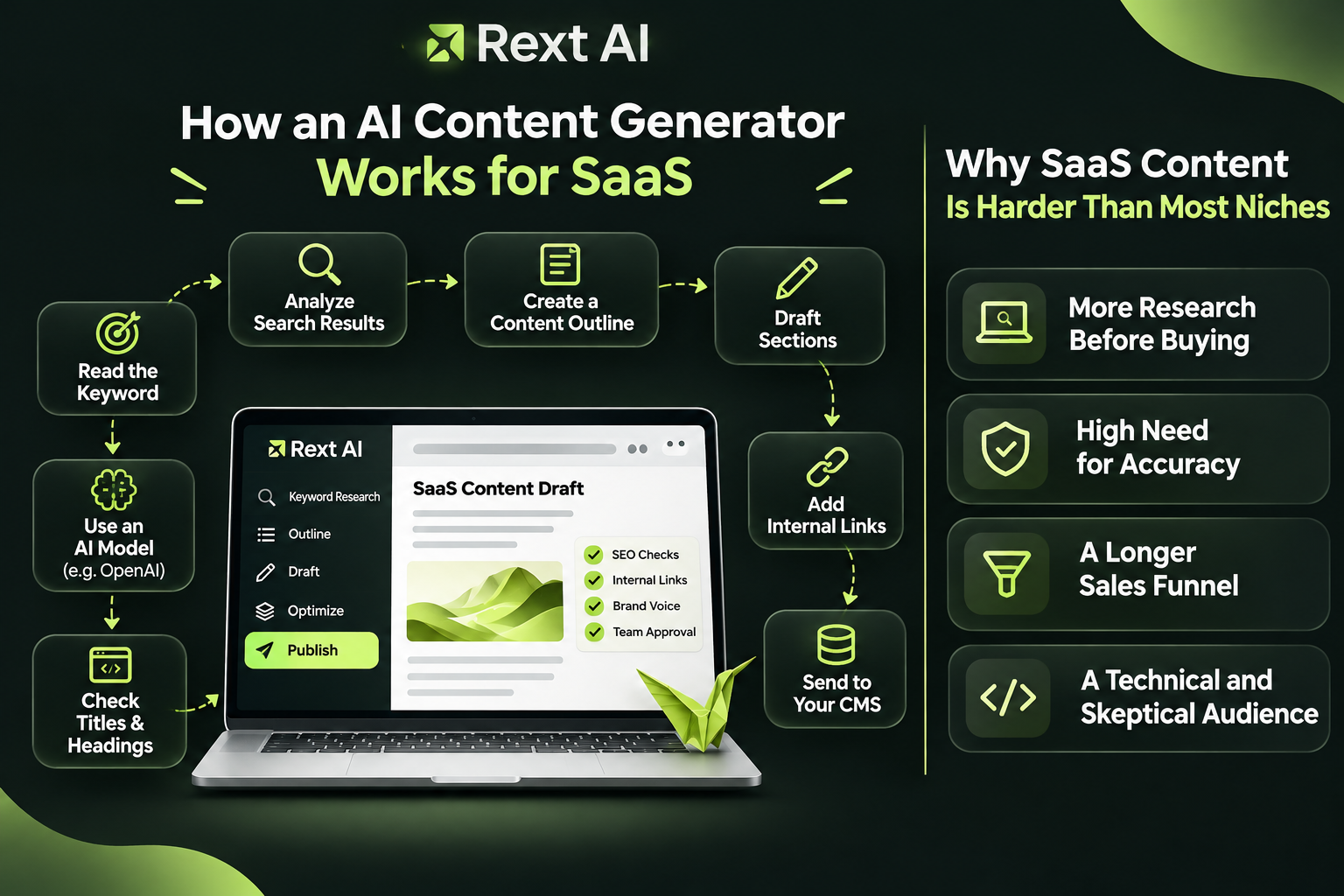
AI drafts are prone to exactly this kind of confident error, because the model fills gaps with plausible detail. Third, the funnel is long. A reader who finds an explainer article may take weeks to sign up for a trial. Content has to support the top of the funnel, the comparison stage, and the decision stage, not just attract clicks.
Finally, SaaS audiences are technical and skeptical. They notice filler. A paragraph that says “in today’s fast-paced digital world, businesses must adapt” tells them the writer does not understand their problem.
These constraints shape what a good tool needs to do. Speed matters, but it is the least important part.
What Top-rated Content Creation for SaaS Looks Like in Practice
Teams that consistently get good results from AI-assisted content tend to share a few habits. They treat the tool as a drafting partner, not as the author. They do keyword and intent research before writing. They approve the structure of an article before the full draft exists. They keep a short list of product facts that every article must respect. And they check the finished piece against real sources and real product details.
When you evaluate a tool, look for these capabilities:
Research that reads the current results. The tool should show you which pages rank for your keyword, what questions they answer, and how long they run. If it generates an outline without reading anything, you are guessing.
An outline you can change before drafting. Approving the structure first is the cheapest place to fix a weak angle. A tool that writes 3,000 words before you see the plan forces you to edit the whole thing.
Visible sources. Each factual claim should point to where it came from. Sources do not make a draft correct, but they make checking it much faster.
Brand voice that comes from real material. A good tool reads your existing pages and learns your tone, then applies it consistently. Without this, every article sounds like it was written by the same generic assistant.
Basic SEO and trust checks. Titles, meta descriptions, heading structure, internal links, and author information should be handled, not left as an afterthought.
A path to publishing. If every article needs to be copied into a CMS by hand, your content calendar will stall within a month.
The Best Tools for Content for SaaS teamsNo single tool fits every team, but the right choice depends on your content volume, budget, team size, and whether your main problem is writing, research, or optimization. Here are some top content generators for SAAS teams: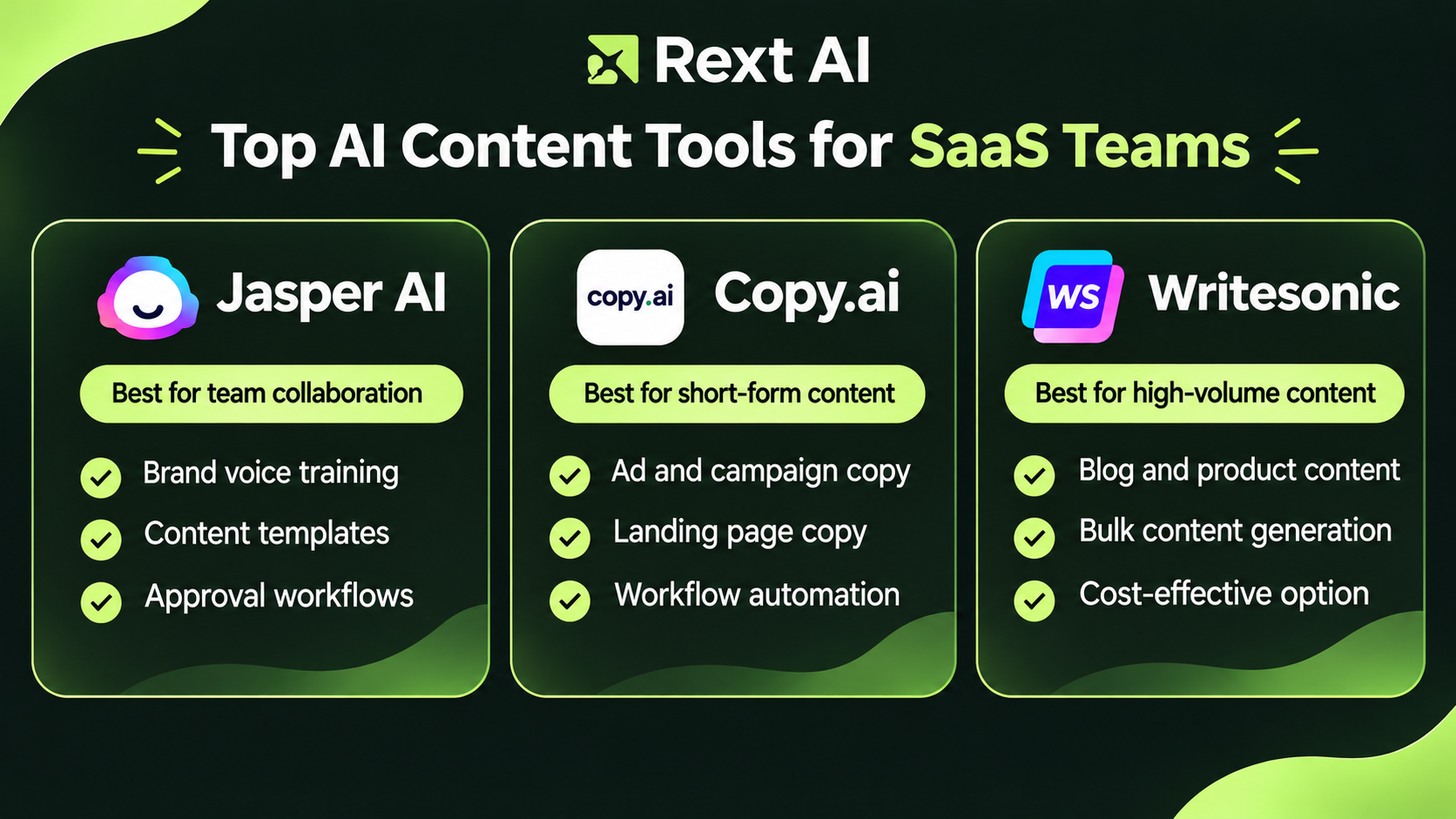
Jasper AI:
Jasper AI is widely used by marketing teams that want brand voice training, templates, and team collaboration in one place. Its approval workflows and template library suit organizations with several writers who need consistent output. The trade-off is cost: Jasper is usually priced above entry-level tools, and teams that only need occasional blog posts may not use its full feature set.
Copy.ai:
Copy.ai is strongest for short-form and go-to-market copy such as ad variants, email subject lines, landing page sections, and social posts. Its workflow automation can help teams produce repeatable assets. For long-form SEO articles, many teams pair it with a dedicated research tool or write the long-form pieces elsewhere.
Writesonic:
Writesonic is often chosen by smaller teams that need volume at a lower price. It covers blog posts, product descriptions, and ad copy, and its bulk generation features help when you want several variations to test. Drafts usually need a careful edit for accuracy and positioning before they are ready for a technical audience.
Anyword:
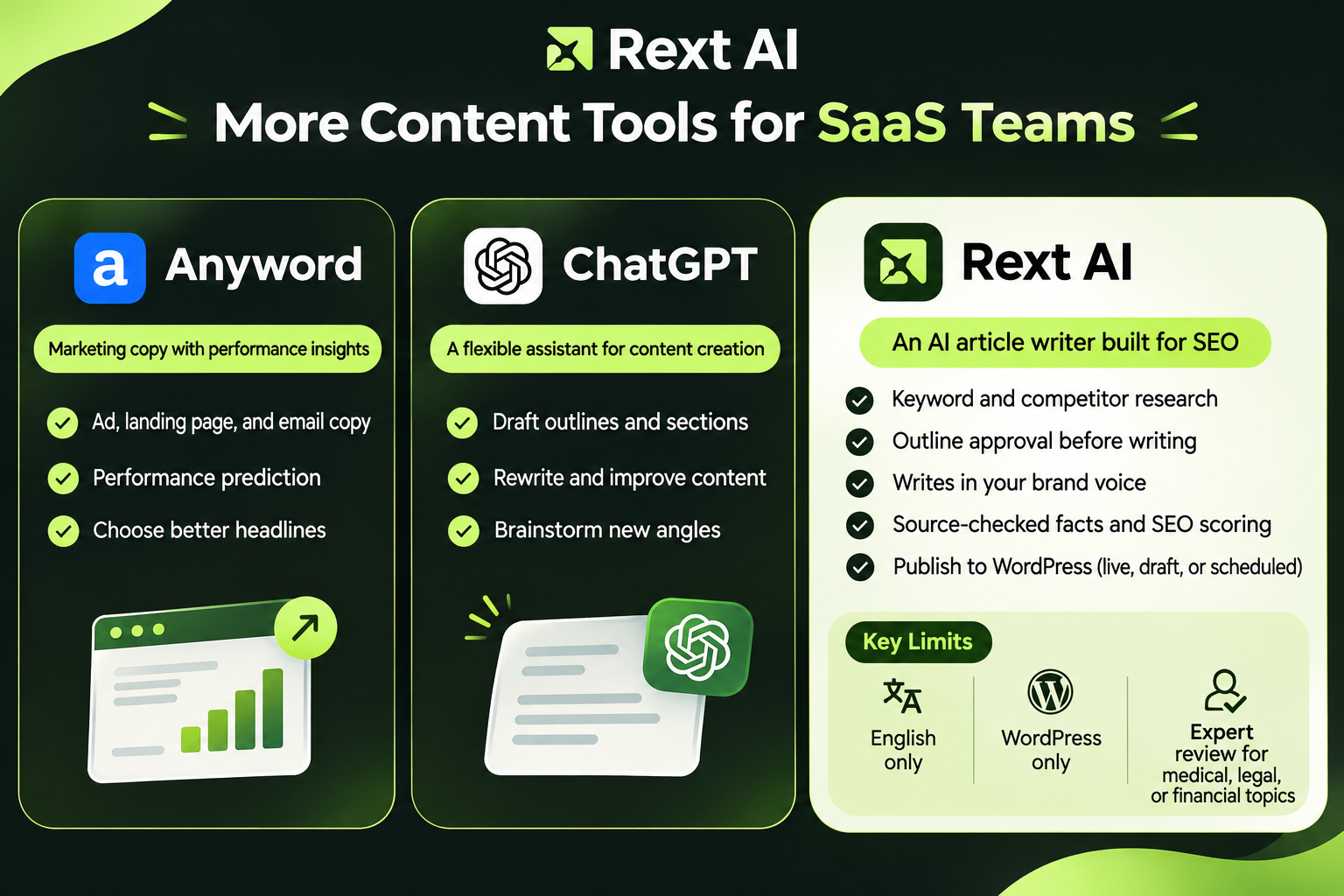
Anyword focuses on marketing copy, particularly ads, landing pages, and email. Its performance prediction features score copy variants against likely engagement, which helps teams choose between headlines before spending on promotion. It is less suited to building a full, research-led blog library, so it works best as a companion to a long-form tool.
ChatGPT and general-purpose chat models:
A general model such as ChatGPT can draft outlines, rewrite sections, and brainstorm angles at little cost. Its weakness is the workflow around it. It does not read the live search results for you, does not track sources as a built-in feature, and does not publish to your CMS. Many experienced writers use a chat model for drafting and a separate process for research and checking. If you go this route, build the research and verification steps yourself.
Rext AI:
Rext AI is an AI article writer for SEO. It is built around a sequence that tends to protect quality. You enter a keyword, and the tool reads the search results and competitor pages. You choose the content type and title, then approve the outline before any article is written. The article is written in your brand voice, which the tool reads from your website when the workspace is set up. The tool then scores the draft on on-page elements and trust signals and can publish it to WordPress as a live post, a draft, a review item, or a scheduled post.
Rext AI also has real limits, and you should weigh them before you sign up. If you need medical, legal, or financial content, it still needs a qualified expert to review the draft. Nothing it produces should be published unread.
For a team with a WordPress site and a need for sourced, reviewed articles, that combination of research, approval gate, and publishing is the main reason to consider it.
Start your free trial; each trial includes 60 credits, which covers about four articles, and does not require a card.
A Practical Workflow for AI-driven SaaS Content Marketing
AI-driven, SaaS-based content marketing software works best when it sits inside a repeatable process. The steps below are one way to structure that process. They are not a fixed formula, and you can adjust them to your team.
1. Choose the buyer question first. Start with a question a prospect would actually ask, not a keyword that looks attractive in a tool. “How do I keep AI-written articles accurate about my product?” is more useful than “AI content” as a starting point.
2. Check intent and competitors. Look at the top results. Are they guides, comparisons, or product pages? The format that already ranks tells you what readers expect. If every result is a listicle, a listicle is a reasonable choice, though you can improve on it with a clearer method.
3. Approve the outline. Read the proposed headings and ask whether each one answers a question your buyer has. Remove sections that repeat each other. Add the product-specific points that only your team knows.
4. Generate the draft in small pieces. Long drafts drift. Generating section by section, or checking each section before moving on, makes errors easier to catch.
5. Verify every product claim. Give the draft to someone who knows the product. Check feature names, integrations, pricing, limits, and dates. This step takes the most time, and it is the one teams most often skip.
6. Check the sources. Open the links behind key statistics and claims. If a source does not say what the draft says it does, rewrite the sentence or remove it.
7. Add something only you can add. A customer quote, a screenshot, a result from your own data, or a clear opinion from a team member gives the article a reason to exist. Generic content with no first-hand detail is the easiest kind for both readers and search systems to ignore.
8. Publish and log it. Record the publication date, the target question, and the keyword. You will need this when you review performance and decide what to update.
Content Formats that Suit SaaS
Not every format works equally well for software companies. Some formats map closely to buyer behavior.
Comparison pages answer “X versus Y” questions. They work when you compare fairly, including where a competitor is stronger. Readers distrust comparisons that only praise the author’s product.
Alternatives pages serve people who already dislike a tool and are looking for a replacement o best alternative for that specific tool or thing. A clear list of alternatives, with the trade-offs for each, performs well when the page is honest about who each option is best for.
Use-case pages show how a specific group, such as a small agency or a growth team, uses your product to solve a problem. They connect product features to real workflows.
Integration pages explain how your product works with another tool. Readers searching for an integration usually have a concrete task in mind, so the page should show the steps.
How-to guides and glossary entries build topical depth and attract early-stage readers. They also give AI systems clear, quotable definitions, which matters for the next section.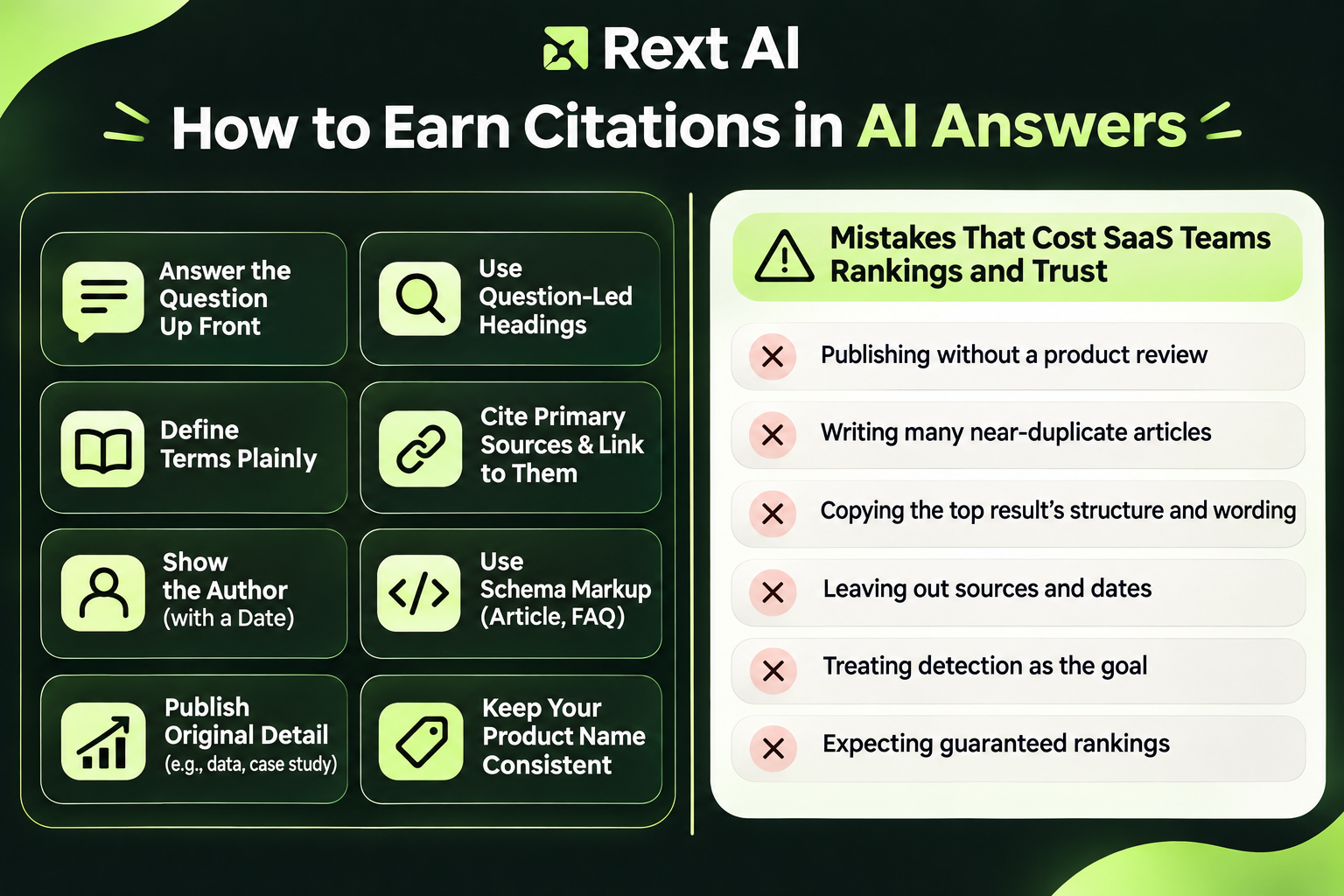
How to Earn Citations in AI Answers
Ranking in Google and being cited in AI answers overlap, but they are not identical because Answer engine optimization (AEO) is about structuring content so that a search result can supply a direct answer. Generative engine optimization (GEO) is about making your content the kind of material AI systems are willing to quote and attribute. Several practical habits support both.
Answer the question in the first sentences under each heading:
A two- or three-sentence direct answer, followed by detail, gives search systems a clean passage to extract. Do not bury the answer under background.
Use headings that match how people ask:
“Is AI content accurate enough for SaaS?” is a better heading than “Accuracy considerations,” because it mirrors the query.
Define terms plainly:
A short, precise definition of “generative AI” or “answer engine optimization” is easy to quote. Keep definitions self-contained so they make sense when read alone.
Cite primary sources and link to them:
Google publishes its own guidance on AI-generated content and spam policies. Linking to primary documents adds credibility and makes your claims checkable. Summarize their position in your own words, and do not paste long passages.
Show the author:
A named author with a relevant role and a short bio helps readers and search systems judge expertise. Include a visible update date and update the article when facts change.
Use schema markup:
Article schema and FAQ schema tell search engines what the page contains. Most CMS plugins can add them. Mark up only the FAQ that appears on the page.
Publish original detail:
A small dataset, a before-and-after example, or a documented customer result is something AI systems cannot find in a dozen other articles. One case study in this article reports a 138% increase in SEO-driven leads over 90 days for one customer, and results like that vary a great deal between sites.
Keep your product name consistent:
If you call your tool one name in the title, another in the body, and a third in the FAQ, AI systems may struggle to connect the pieces. Pick one name and use it throughout.
Mistakes that Cost SaaS Teams Rankings and Trust
Publishing without a product review.
The most damaging error is an article that is wrong about what your product does. One incorrect integration claim can undermine the whole site.
Writing many near-duplicate articles.
Ten posts targeting slightly different versions of the same question split your signals and rarely help. Consolidate instead, and make each page answer a distinct intent.
Copying the top result’s structure and wording.
Using the same headings as the current first page is not the same as covering the topic well. Add a point of view, a method, or data the others lack.
Leaving out sources and dates.
An article with no sources, no author, and no update date looks like filler to readers and to search systems alike.
Treating detection as the goal.
Some teams focus on whether a text will pass an AI detector. Detectors are unreliable, and the question that matters more is whether the article is accurate, useful, and written for a person. Google’s guidance is about helpfulness and quality, not about the method of production. Write for the reader first.
Expecting guaranteed rankings.
No tool can promise a position in search results. Results depend on competition, authority, links, and how well the page serves the query over time.
How To Measure Whether It Works:
Measure content over months, not days. Start with Google Search Console, where you can see impressions, clicks, and average position for the queries each page appears for. Look for pages that earn impressions but few clicks, because a better title or a clearer answer may lift them. Look for pages in positions eight to twenty, because a small improvement can move them onto the first page.
Track sign-ups and trials from organic traffic in your analytics tool, and tag articles by funnel stage so you can see which ones contribute to revenue, not only visits. For AI visibility, check whether your brand and pages appear in answers to your target questions in the major assistants. Manual checks are slow but informative, and some visibility tools now automate them.
Set a 30-day review for each article. If an article earns impressions but no clicks, revise the title and the opening answer. If it ranks but does not convert, look at the call to action and whether the page answers the next question a buyer would ask. If its facts are out of date, update them and change the date.
Frequently Asked Questions
Will Google penalize articles written with an AI tool?
Google’s published guidance says that using AI or automation is not against its guidelines in itself. Its spam policies target content created mainly to manipulate rankings rather than to help people, and that applies regardless of what tool was used. The practical takeaway is to focus on usefulness and accuracy, not on how the draft was produced.
What is the best content creator for SaaS?
There is no single best tool. Teams that need brand voice controls and approvals often look at Jasper AI. Teams focused on short ad and email copy often look at Copy.ai or Anyword. Budget-conscious teams that need volume often look at Writesonic. Teams that want sourced, outline-approved SEO articles published to WordPress often look at Rext AI. Choose by the job you need done, and test with a real keyword before you commit.
Can AI write accurate product content for my SaaS company?
A tool can write fluently about your product category. Accuracy about your specific features, integrations, and pricing depends on the information you give it and on a person checking the final draft. Keep a short document of product facts that every article must match, and give it to the tool and to your reviewer.
How can my content get cited by ChatGPT, Perplexity, or Google AI Overviews?
Write clear answers near the top of each section, use question-based headings, define terms precisely, cite primary sources, show the author and update date, and publish original detail that others do not have. Keep your product name consistent. There is no guaranteed method, but these habits make your pages easier to quote and easier to trust.
About the Author

Sania Usman
Sania is a technical writer at Rext AI with five years of experience in writing for SaaS products and technical writing. She joined Rext AI to make technical content clear without oversimplifying it. Sania specializes in topic clusters, on-page optimization, SaaS articles, and content that answers the questions people are actually searching for.